
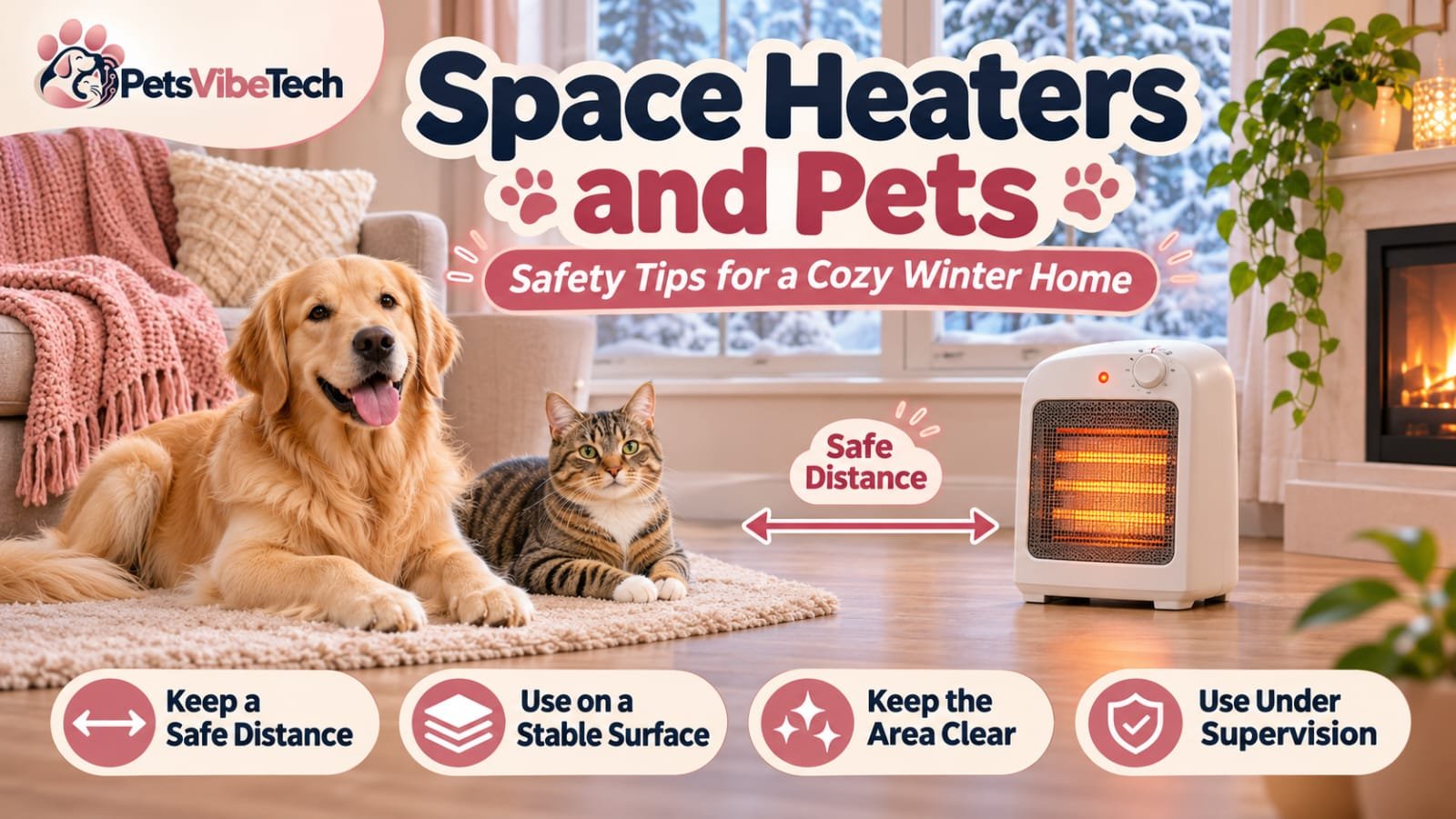
Space heaters and pets can share a room safely if the heater has tip-over and overheat shut-off, sits at least three feet from your pet’s bed and anything that can burn, plugs straight into a wall outlet, and is switched off whenever nobody is in the room. A smart plug can help, but only for automatic off schedules within the plug’s rating, never to turn a heater on remotely while you’re away.
Check prices on Amazon: Space heaters with tip-over and overheat shut-off · Self-warming pet beds
Related guide: Heated pet bed safety: 9 checks
Cold nights send cats and dogs straight to the warmest spot in the house, and a space heater is often it. That’s exactly why heaters and pets need a plan: a curious cat, a wagging tail or a dog bed pushed too close can turn a cozy corner into a hazard.
This guide covers the safety features worth paying for, where to put the heater, what to do about cords, and the honest answer to a question smart-home owners keep asking: is it safe to put a space heater on a smart plug?
How we evaluated
| Criterion | Why it matters | Where we checked |
|---|---|---|
| Safety shut-offs | Tip-over and overheat protection stop the heater if it falls or runs too hot | CPSC guidance; heater maker guidance |
| Placement distance | Most heating fires start when something that can burn is too close | CPSC; NFPA data as reported |
| Cords and outlets | Extension cords and power strips can overheat under heater loads | Heater maker guidance; smart plug maker load limits |
| Smart plug limits | A plug rated below the heater’s draw can overheat | TP-Link’s published load guidance for Tapo/Kasa plugs |
| Pets specifically | Pets knock things over, chew cords and nap too close | CPSC; heater maker guidance |
What we didn’t do: PetsVibe Tech did not test heaters or smart plugs by hand or measure temperatures. This guide is built from the official sources listed at the end, checked on November 8, 2026. Always follow your own heater’s and plug’s manuals.
Quick verdict: what makes a space heater pet-safe
| Feature | Why it matters with pets | Must-have? |
|---|---|---|
| Tip-over shut-off | A dog or cat can knock a heater over | Yes |
| Overheat protection | Shuts the heater off if internal parts get too hot | Yes |
| Safety listing (UL, ETL, CSA) | Tested by a recognized lab | Yes |
| Cool-touch housing | Lowers burn risk for noses and paws | Strongly recommended |
| Enclosed elements (no glowing coils in reach) | Paws and tails stay away from hot parts | Strongly recommended |
| Built-in timer or thermostat | Limits run time without extra gadgets | Recommended |
| Heavy, wide base | Harder to tip in the first place | Recommended |
I would choose / I would not choose
I would choose a listed electric heater with tip-over and overheat shut-off, a cool-touch case and a built-in thermostat or timer, placed on a hard floor at least three feet from the pet bed, plugged directly into the wall, and switched off when I leave the room.
I would not choose an older heater without tip-over protection, any heater with exposed glowing elements at pet height, or a setup that relies on an extension cord, a power strip or a smart plug to turn the heater on while nobody’s home.
In this guide
- Why space heaters and pets need extra care
- Where to put a space heater in a pet home
- Cords, outlets and extension cords
- Space heaters on smart plugs: the honest answer
- Worked example: will your smart plug handle your heater?
- Safer ways to keep pets warm
- Checklist and FAQs
Why space heaters and pets need extra care
Heating equipment is one of the leading causes of home fires in the US. As reported from the National Fire Protection Association’s 2011–2015 data, space heaters accounted for 43% of home heating fires but 85% of home heating fire deaths, and December, January and February are the peak months.
Pets add their own risks. They lie close to warm things for hours, they knock objects over, and puppies and kittens chew cords. The US Consumer Product Safety Commission (CPSC) puts it simply: keep children and pets away from space heaters.
Where to put a space heater in a pet home
The CPSC recommends keeping a space heater at least three feet from bedding, drapes, furniture and other flammable materials. In a pet home, “bedding” includes the dog bed, the cat tree and the blanket on the couch your cat sleeps on.
- Hard, level floor. Not on a rug, bed or sofa.
- Three-foot zone. No pet bed, toys, curtains or laundry inside it.
- Out of the walkway. Not where the dog runs to the door or the cat jumps down from the window.
- Pet bed nearby, not next to it. Let your pet choose the distance; warmth travels.
- Off when you leave the room or go to sleep, as the CPSC advises.
Cords, outlets and extension cords
Space heaters draw a lot of current. Heater guidance from Lasko is blunt: never use extension cords or power strips with heaters. Plug the heater directly into a wall outlet, keep the cord out of chewing range, and don’t run it under rugs where it can overheat or get damaged.
If you have a cord chewer, block access to the outlet area with furniture or a pet gate rather than relying on a cord cover alone.
Space heaters on smart plugs: the honest answer
A smart plug can make a heater safer in one way: an automatic off schedule means the heater can’t run all night by accident. It can make it riskier in two ways: the plug may not be rated for the heater’s load, and remote “on” lets you start a heater in an empty room.
What the plug maker says: TP-Link’s guidance for its Tapo/Kasa plugs lists heaters as a supported resistive load within the plug’s rating (its EU P100 example: up to 10 A / 2300 W at 230 V), says loads above the rating aren’t supported, recommends keeping long-running loads at or below 80% of the maximum rating, and discourages plugging a power strip into the smart plug. Ratings vary by model and region, so check yours.
Our rules for space heaters and pets on a smart plug:
- Rated for it: the heater’s current must stay at or below 80% of the plug’s rating (see the worked example).
- Off schedules only: use the plug to switch the heater off at bedtime or when you leave. Don’t turn it on remotely when nobody is home; the CPSC advises turning heaters off when you leave the area.
- Heater’s own safety first: the plug doesn’t replace tip-over or overheat protection.
- Check for warmth: if the plug feels warm, stop and check its rating and the manual.
- When in doubt, use the heater’s built-in timer instead of a smart plug.
Worked example: will your smart plug handle your heater?
Current (amps) = watts ÷ volts. Compare it with 80% of the plug’s amp rating.
| Heater setting | Voltage | Current | 15 A plug (80% = 12 A) | 10 A plug (80% = 8 A) | 16 A plug (80% = 12.8 A) |
|---|---|---|---|---|---|
| 1,500 W (US high) | 120 V | 12.5 A | Over the 80% guide | Over | n/a |
| 750 W (US low) | 120 V | 6.25 A | OK | OK | n/a |
| 2,000 W | 230 V | 8.7 A | n/a | Over the 80% guide | OK |
| 1,000 W | 230 V | 4.3 A | n/a | OK | OK |
A typical 1,500 W heater on high is above the 80% guide for a 15 A plug. If you want a smart plug in the chain, run the heater on its low setting or choose a plug rated for the full load, and still follow the off-only rule.
Safer ways to keep pets warm
- A self-warming or low-wattage pet bed puts warmth where your pet sleeps. See our heated pet bed safety guide.
- Block drafts at doors and windows and raise beds off cold floors.
- Warm the room before bedtime, then switch the heater off.
- Check in remotely with a pet camera without a subscription instead of leaving a heater running while you’re out.
Practical scenarios
| Situation | What to do |
|---|---|
| Senior dog sleeps all day by the heater | Move the bed outside the three-foot zone; add a low-wattage heated pad on part of the bed |
| Cat loves sitting on top of the heater | Choose a cool-touch model with a sloped or narrow top, and switch it off when you’re not watching |
| You work from home in a cold office | Heater on while you’re there; smart plug off schedule at lunch and end of day |
| Leaving for the weekend | Heater unplugged; keep pets warm with bedding and a draft-free room |
| Puppy chews everything | No heater cord within reach; gate off the outlet area |
Space heaters and pets checklist
- Listed heater with tip-over and overheat shut-off
- Cool-touch case, no exposed glowing elements at pet height
- Hard, level floor, at least three feet from pet beds and anything flammable
- Plugged straight into a wall outlet, no extension cord or power strip
- Cord out of chewing range
- Off when you leave the room or go to sleep
- Smart plug only if rated for the load (80% guide), and only for off schedules
Safer heating options for pet homes
- Space heater with tip-over and overheat shut-off — look for a cool-touch case and a safety listing. Amazon
- Self-warming pet bed — no electricity at all. Amazon
- Thermostat-controlled pet heating pad — low-wattage and made for pets. Amazon
- Heavy-duty 15A smart plug — for off-schedules only, and only within its rated load. Amazon
Affiliate links: we may earn a commission at no extra cost to you. Prices change, so check the listing before you buy.
FAQs
Are space heaters safe for cats and dogs?
They can be, with the right heater and setup: tip-over and overheat protection, three feet of clearance, a direct wall connection, and the heater off when nobody is in the room.
How far should a space heater be from a pet bed?
At least three feet, the same distance the CPSC recommends from bedding, drapes and furniture.
Can I leave a space heater on for my dog while I’m at work?
We don’t recommend it. The CPSC advises turning space heaters off when you leave the area. Use bedding, draft-proofing or a low-wattage pet bed instead.
Can I plug a space heater into a smart plug?
Only if the plug is rated for the heater’s load. Keep the heater’s current at or below 80% of the plug’s rating for long use, and use the plug for off schedules, not remote on.
Can I use an extension cord with a space heater?
Heater guidance says no: plug it directly into a wall outlet.
What safety features matter most in a heater for a pet home?
Tip-over shut-off, overheat protection, a recognized safety listing and a cool-touch case.
My cat sits on the heater. Is that dangerous?
It can be. Choose a cool-touch model, keep it off when unsupervised, and give your cat a warmer bed somewhere else.
What’s safer than a space heater for pets?
A self-warming bed or a thermostat-controlled, pet-specific heated pad, plus blocking drafts.
Final verdict
Space heaters and pets can coexist if you treat the heater as a supervised appliance: the right safety features, three feet of clearance, a direct wall connection and off whenever you leave. A smart plug is a useful off switch, not a remote on switch, and only within its rating. For warmth while you’re away, warm the pet instead of the room.
Sources and references
- US CPSC: tips to prevent home fires from space heaters
- NFPA home heating fires report (2011–2015 data), as reported by Occupational Health & Safety
- Lasko: portable and safe heaters, what you need to know
- TP-Link: what loads can be connected to Tapo/Kasa plugs
Sources checked on November 8, 2026. General information, not a substitute for your heater’s manual or professional advice.



Share your experience