
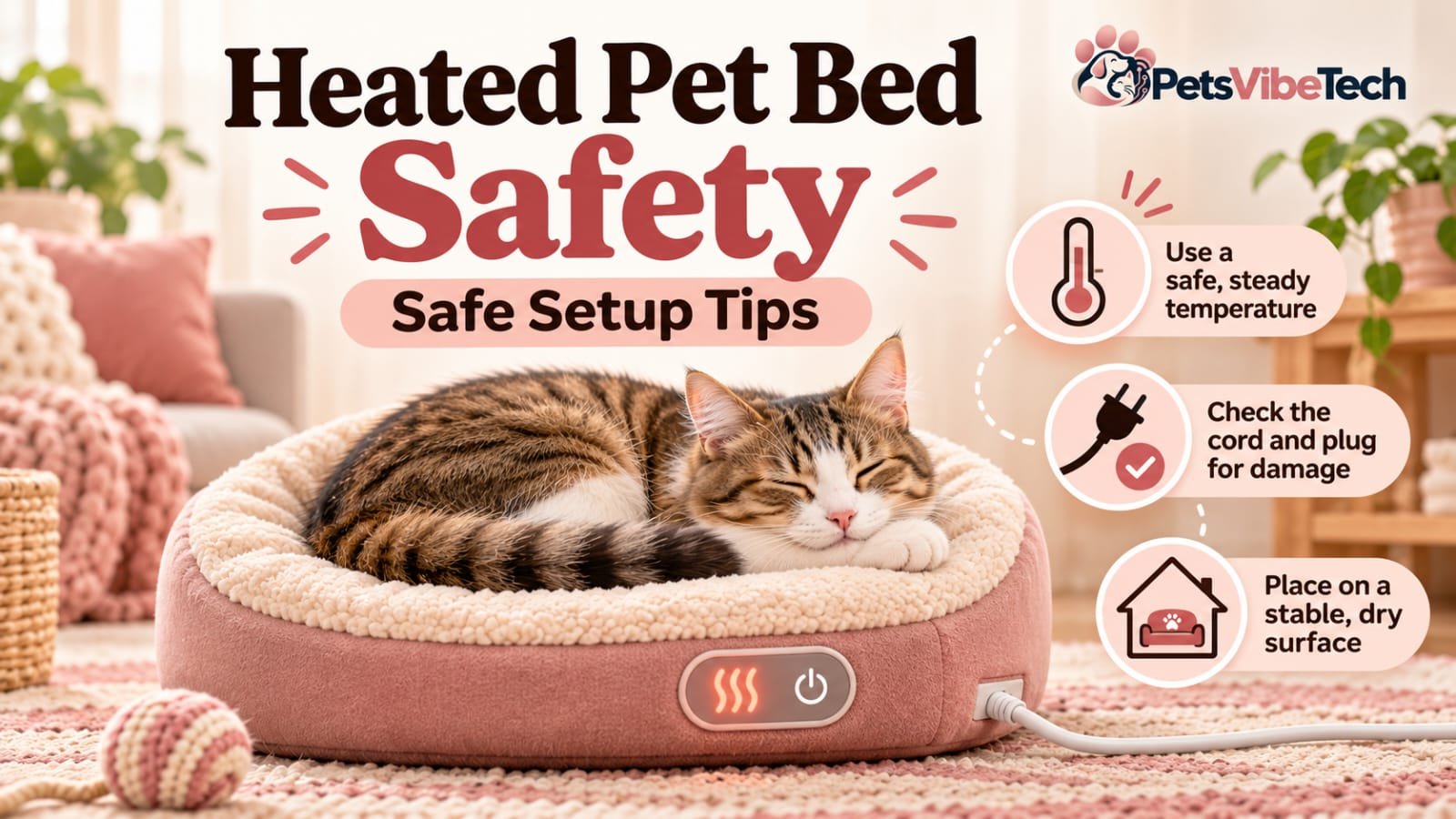
A heated pet bed is safe for most healthy adult cats and dogs when it is built for pets, warms only to around body temperature, sits on a cord your pet cannot chew, and leaves room to move off the heat. The safest designs are low-wattage, thermostat-controlled pads that are safety-certified and plugged straight into the wall. Self-warming beds that use no electricity are the zero-risk option. Kittens, puppies, very old pets and pets recovering from surgery should only use one after you check with your vet.
Check prices on Amazon: K&H Thermo-Kitty Mat (indoor) · K&H Lectro-Kennel (outdoor-rated)
Related guide: Space heaters and pets: 7 safety checks
Cold floors, drafty rooms and long winter nights send many cats and dogs looking for the warmest spot in the house. A heated pet bed can give them that spot, and for older pets with stiff joints it can make winter noticeably more comfortable. It is also a mains-powered heating product that your pet will lie on for hours, often while you are asleep or out.
This guide explains how the main types of heated beds work, what the manufacturers actually promise, which safety features matter, and how to set one up so the warmth stays comfortable instead of risky.
How we evaluated
| Criterion | Why it matters | Where we checked |
|---|---|---|
| Temperature control | A bed that keeps heating with no limit can overheat a pet that cannot move away | Manufacturer product pages and manuals |
| Safety certification | An independent listing (MET, UL, ETL) means the design was tested against an electrical safety standard | Certification statements on the product pages |
| Cord protection | Chewing a live cord is a serious hazard for puppies, kittens and rabbits | Cord descriptions (length, steel wrap) |
| Power draw and running cost | Low wattage means less heat at the surface and a smaller power bill | Rated wattage from the manufacturer |
| Indoor vs outdoor rating | Indoor pads are not built for damp garages or porches | Manufacturer use instructions |
| Who should not use it | Some pets cannot regulate temperature or move away easily | Manufacturer warnings and veterinary hospital guidance |
What we didn’t do: PetsVibe Tech did not test these beds by hand, measure surface temperatures, or run them for weeks. Everything here comes from manufacturer specifications and veterinary sources listed at the end, checked on November 6, 2026. Always follow the manual that comes with your product.
Quick verdict: heated pet bed types compared
| Type | Power | How heat is controlled | Main risk | Best for |
|---|---|---|---|---|
| Self-warming bed (reflective layer) | None | Reflects your pet’s own body heat | Almost none; less warmth on very cold nights | Healthy pets, kittens with vet approval, homes where cords are a problem |
| Low-wattage thermostat pad (indoor) | Mains, a few watts | Built-in thermostat warms toward pet body temperature | Chewed cord; use with extension cords | Indoor cats and small dogs, older pets with stiff joints |
| Outdoor-rated heated pad | Mains, tens of watts | Thermostat, rigid shell, steel-wrapped cord | Placement in wet areas; higher power | Sheltered garages, barns, outdoor cat shelters |
| Microwavable heat disc | Heated in a microwave | No control once heated; cools over hours | Overheating if heated too long | Short-term warmth, power cuts, transport |
| Human heating pad | Mains | Settings for people, often high heat | Not designed for pets to lie on for hours or to chew | Not recommended for pet beds |
I would choose / I would not choose
I would choose a low-wattage, thermostat-controlled pad that is designed for pets, carries an independent safety listing, and covers only part of the bed so my pet can move off the heat. For a pet that chews cords, I would choose a model with a steel-wrapped cord or skip electric heat entirely and use a self-warming bed.
I would not choose a human heating pad, an electric blanket, or any pad with no thermostat for a pet bed. I would also not run any heated bed through an extension cord or power strip if the manual says not to.
In this guide
- How a heated pet bed controls temperature
- Two real examples from the manufacturer’s specs
- What it costs to run a heated pet bed
- 9 safety checks before you plug one in
- Pets that need a vet’s OK first
- Signs of a heat burn and what to do
- Practical scenarios
- FAQs
How a heated pet bed controls temperature
Most electric pet beds use a thermostat rather than a simple on/off heater. The idea is that the surface stays only a little above room temperature when the bed is empty, then warms toward your pet’s normal body temperature when your pet lies on it and traps the heat. That is very different from a human heating pad, which is designed to deliver a set level of heat to a person who can feel it and turn it off.
Self-warming beds work without electricity. A reflective or insulating layer inside the bed sends your pet’s own body heat back toward them. They cannot overheat a pet because they add no heat of their own, but they are also less effective in a very cold room.
Microwavable heat discs sit in the middle: they hold heat for a period after warming and then cool down. They have no thermostat, so the heating time printed by the maker matters.
Two real heated pet bed examples from the manufacturer’s specs
These are not endorsements and we did not test them. They are useful because their makers publish clear specifications that show what to look for.
K&H Thermo-Kitty Mat (indoor)
According to K&H Pet Products, the Thermo-Kitty Mat uses 6 watts, measures 12.5 x 25 inches, and is thermostatically controlled to warm the surface toward a pet’s normal body temperature (around 102°F) when in use. With no pet on it, the surface sits about 15°F above room temperature. It has no on/off switch and is always on when plugged in. K&H says it is MET listed, designed for indoor use, comes with a 5.5-foot cord, and should not be used with an extension cord. The company also advises checking with a vet before using it with young kittens or puppies, convalescent pets, or pets recovering from surgery. Warranty: 1 year, limited.
K&H Lectro-Kennel (outdoor-rated)
The Lectro-Kennel is K&H’s heated pad for sheltered outdoor spaces. The company lists three sizes at 40, 60 and 80 watts, a rigid ABS shell, a 5.5-foot steel-wrapped cord and a removable fleece cover, with a thermostat that warms toward the pet’s body temperature when in use. It is meant for sheds, garages and other sheltered areas, not for open, wet ground.
What it costs to run a heated pet bed
Wattage tells you the most a pad can draw. Because thermostat pads cycle, real use is usually lower, so treat these as upper limits.
| Pad | Rated power | Maximum per day (24 h) | Maximum per year |
|---|---|---|---|
| 6 W indoor mat | 6 W | 0.144 kWh | about 53 kWh |
| 40 W outdoor pad (small) | 40 W | 0.96 kWh | about 350 kWh |
| 80 W outdoor pad (large) | 80 W | 1.92 kWh | about 701 kWh |
Worked example: if your electricity costs 17 cents per kWh (use the rate on your own bill), a 6 W mat running all year costs at most about 53 x 0.17 = about $9. A large 80 W outdoor pad running all winter (about 120 days) costs at most about 1.92 x 120 x 0.17 = about $39. You can compare running costs of other pet devices in our pet tech cost calculator.
9 safety checks before you plug in a heated pet bed
- Built for pets. Use a product designed and labeled for pets, not a human heating pad or electric blanket.
- Thermostat or low heat. Look for a stated thermostat or a surface temperature close to pet body temperature, not just “warm.”
- Independent safety listing. MET, UL or ETL listing on the product or page.
- Cord protection. For chewers, a steel-wrapped cord, a cord protector, or no electric heat at all.
- Straight into the wall. Follow the manual on extension cords. The Thermo-Kitty Mat, for example, says not to use one.
- A cool zone. Place the pad so it covers only part of the bed, or leave an unheated bed nearby, so your pet can move away from the heat.
- Cover on, always. Keep the fabric cover on and never put extra blankets under the pad.
- Indoor vs outdoor. Use outdoor-rated pads in garages and sheds; keep indoor mats indoors and dry.
- Inspect every week. Check the cord, plug and pad for chew marks, cracks or hot spots, and unplug during long absences if the maker suggests it.
Pets that need a vet’s OK before a heated pet bed
Some pets cannot sense heat well, cannot move away easily, or cannot regulate their body temperature as well as a healthy adult. Talk to your vet before using any electric heat for:
| Pet | Why to ask first |
|---|---|
| Very young kittens and puppies | Less able to regulate body temperature or move off the heat |
| Pets recovering from surgery or anesthesia | May be drowsy, immobile or have reduced sensation |
| Very old or arthritic pets | May not shift position often; warmth can help, but placement matters |
| Pets with nerve problems or paralysis | May not feel heat building up |
| Pets that chew everything | Cord risk outweighs the benefit |
A self-warming bed is a gentler starting point for many of these pets, again with your vet’s input.
Signs of a heat burn and what to do
Lort Smith Animal Hospital lists electric heating pads among the causes of thermal burns in pets and notes that the full extent of a burn can take up to 3 days to develop. Signs include reddened, blistered or swollen skin, pain when touched, and singed hair.
If you suspect a burn, the hospital’s first-aid steps are: move your pet away from the heat source, cool the area with cool water (avoid full immersion for large areas because of shock risk), cover it with a clean, moist, non-stick cloth, do not apply creams or ointments, and see a vet immediately.
*This section is general information and not a substitute for advice from your veterinarian.*
Practical scenarios
| Situation | What to do |
|---|---|
| Senior cat sleeps all day in a cold room | A low-wattage thermostat mat on part of the bed, plus a second unheated bed nearby |
| New kitten in winter | Ask your vet first; start with a self-warming bed |
| Puppy that chews cords | No electric bed for now, or a steel-wrapped cord model with a protector |
| Outdoor cat shelter in a garage | An outdoor-rated pad with a steel-wrapped cord, kept dry |
| Power cut on a cold night | Unplug the electric pad, add a self-warming bed or an extra blanket; see our guide to feeder battery backup for keeping other devices running |
| Away for the weekend | Follow the maker’s advice on unplugging during long absences, and check in with a pet camera without a subscription |
Heated pet bed safety checklist (printable)
- Product is made for pets and safety-listed
- Thermostat or stated low surface temperature
- Cord out of reach or steel-wrapped
- Plugged straight into a wall outlet
- Cool zone available next to the heat
- Fabric cover on, nothing tucked under the pad
- Indoor pad used only indoors
- Weekly check of cord, plug and pad
- Vet approval for kittens, puppies, seniors and post-surgery pets
FAQs
Are heated pet beds safe to leave on all day?
Some are designed for continuous use. K&H, for example, says its Thermo-Kitty products are designed for 24/7 operation while also suggesting unplugging during extended absences. Follow your own product’s manual.
Can I use a human heating pad under my pet’s bed?
We don’t recommend it. Human heating pads are designed for people who can feel the heat and switch it off, not for pets lying on them for hours or chewing the cord.
What temperature should a heated pet bed reach?
Thermostat pads for pets aim for around pet body temperature when occupied. K&H states about 102°F for its Thermo-Kitty Mat, and about 15°F above room temperature when empty.
Do self-warming pet beds work?
They reflect your pet’s own body heat, so they feel warmer than a plain bed but add no heat of their own. They are best in rooms that are cool rather than very cold.
Is a heated bed good for an arthritic dog or cat?
Warmth can make stiff pets more comfortable, but older pets may not move away from heat as quickly. Ask your vet and always leave a cooler spot nearby.
Can I use an extension cord?
Only if the manual allows it. Some makers, including K&H for the Thermo-Kitty Mat, say not to.
How much electricity does a heated pet bed use?
It depends on wattage. A 6 W indoor mat uses at most about 0.144 kWh a day; an 80 W outdoor pad at most about 1.92 kWh a day.
Can I put a heated pad in an outdoor dog house?
Use only a pad rated for outdoor or sheltered use, with a protected cord, and keep it dry.
What should I do if my pet has a red patch after using the bed?
Stop using the bed, cool the area as described above, and contact your vet. Burns can take up to 3 days to show their full extent.
Final verdict
A heated pet bed is worth it for many indoor pets, especially older ones, as long as you pick one designed for pets with a thermostat, a safety listing and a protected cord, and you give your pet a way to move off the heat. If cords are a problem or your pet is very young, start with a self-warming bed. Whatever you choose, the manual and your vet beat any general guide, including this one.
Sources and references
- K&H Pet Products: Thermo-Kitty Mat specifications
- K&H Pet Products: Lectro-Kennel outdoor heated pad
- Lort Smith Animal Hospital: Thermal burns in cats
Sources checked on November 6, 2026.



Share your experience