
💡 Quick Answer
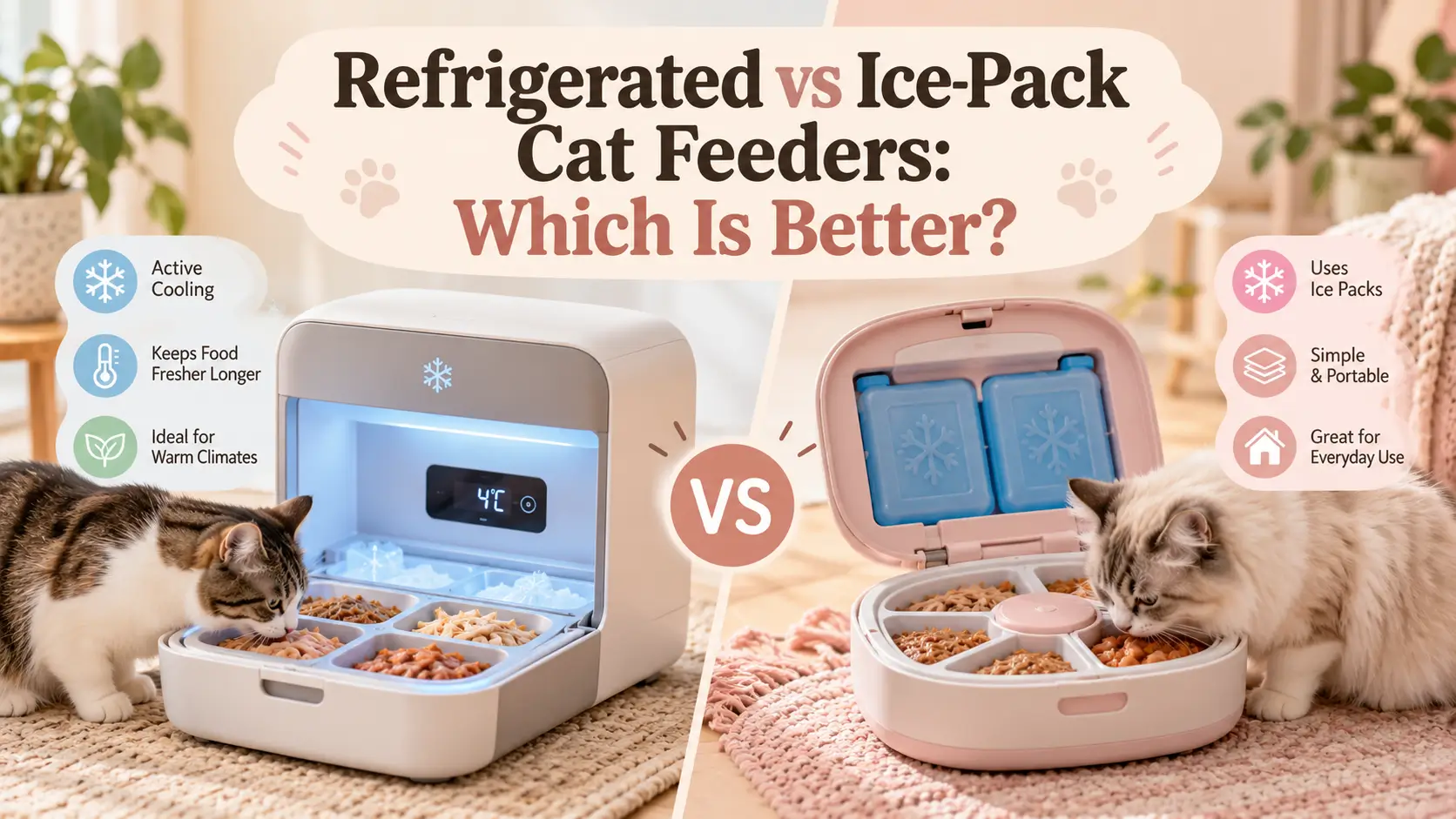
In the refrigerated vs ice-pack cat feeders comparison, a refrigerated feeder is generally better for longer scheduled wet-food storage—provided it actually maintains food at 40°F (4.4°C) or below. Ice-pack feeders are simpler and usually less expensive, but their cooling fades over time. Neither system guarantees food safety without appropriate temperature control and cleaning.
You’re getting ready for work.
Your cat eats wet food, and you’d like an automatic feeder to serve lunch while you’re away.
You find two appealing options.
The first costs considerably more but promises built-in refrigeration. The second uses reusable ice packs and a rotating food tray.
Both can open a compartment at the scheduled time.
Both are marketed as suitable for wet food.
But they are not equally capable of keeping perishable food cold.
That difference matters more than whether the feeder has Wi-Fi, a stainless steel bowl, or a particularly attractive design.
The real challenge is keeping the prepared meal at an appropriate temperature between the moment you load it and the moment your cat eats it.
Refrigerated feeders use electricity to remove heat. Ice-pack feeders rely on stored cold that gradually runs out.
However, there’s an important complication: not every product marketed as refrigerated maintains the temperature of a household refrigerator.
In this guide, we’ll compare the two cooling methods, examine real manufacturer specifications, and build a practical decision framework around your cat’s actual routine.
Rather than simply declaring one type better, we’ll look at the circumstances in which each makes sense—and when neither is appropriate.
How We Evaluated This Comparison: This guide uses manufacturer-published technical specifications, food-storage guidance, and an analysis of everyday feeding requirements. PetsVibe Tech has not independently tested cooling performance. Manufacturer temperature claims are identified as such, not presented as independently verified results.
🏆 Quick Verdict: Refrigerated vs Ice-Pack Cat Feeders
A properly functioning feeder that maintains appropriate refrigeration temperatures is the stronger choice when prepared wet food must remain stored for a longer period before serving.
An ice-pack feeder can be convenient for shorter routines, but only when its cooling performance has been assessed under the conditions in which it will be used.
Head-to-Head Comparison
| Feature | Refrigerated Feeder | Ice-Pack Feeder |
|---|---|---|
| Cooling method | Powered cooling system | Frozen reusable packs |
| Temperature regulation | Model-dependent | No active regulation |
| Cooling over time | Continues while functioning and powered | Gradually weakens |
| Wall outlet required for cooling | Usually yes | No |
| Operation during a power outage | Active cooling stops unless separately backed up | Ice packs continue absorbing heat temporarily |
| Typical purchase cost | Higher | Lower |
| Technology complexity | More components | Simpler design |
| App scheduling | Available on many models | Usually unnecessary |
| Maintenance | Trays, seals, vents, cooling components | Trays and ice packs |
| Longer wet-food storage | Potentially suitable if correct temperature is maintained | Not reliably established without testing |
| Main concern | Actual temperature performance and power reliability | Limited and variable cold-holding time |
I Would Choose Refrigerated If…
- My cat needs prepared wet meals later in the day.
- I want to avoid changing frozen packs before every feeding schedule.
- The device has documented temperature performance appropriate for perishable food.
- I have a reliable electrical supply.
- I can monitor and maintain the cooling system.
I Would Choose Ice Packs If…
- I need a straightforward timer with no Wi-Fi setup.
- My feeding window is short enough to maintain appropriate food temperatures.
- I’m willing to freeze and replace the packs.
- I prefer simpler, less expensive equipment.
- I can verify cooling performance in the intended room.
I Would Choose Neither If…
- The food cannot be kept at an appropriate storage temperature.
- I need to leave highly perishable food unattended without reliable cooling.
- My cat cannot safely access the device.
- The feeder repeatedly misses scheduled openings.
- I cannot arrange a backup when the equipment fails.
Our verdict: Prioritize measurable temperature performance over the marketing label. A feeder that maintains 40°F or below is more useful for refrigerated storage than one that merely feels cool.
📖 In This Guide
1. How Refrigerated and Ice-Pack Feeders Work
2. The Temperature Difference That Matters
3. Real Product Examples
4. Which Type Fits Your Feeding Schedule?
5. What Happens During a Power Outage?
6. Purchase Price and Long-Term Ownership Costs
7. How to Check Cooling Performance
8. Cleaning, Maintenance, and Common Failures
9. Frequently Asked Questions
🧊 How Do Refrigerated and Ice-Pack Cat Feeders Actually Work?
Both systems are designed to delay the warming of prepared food, but they achieve this in different ways.
Understanding how they work helps explain why cooling performance varies.
How a Refrigerated Cat Feeder Works
An actively cooled feeder uses an electrical system to move heat away from its food-storage compartment.
Some models use thermoelectric or semiconductor cooling technology.
A thermoelectric element transfers heat from one side of the device to another. Heat sinks, fans, and ventilation help release that heat into the surrounding room.
The important feature is that the device can continue removing heat while it has power.
But the amount of cooling depends on several factors:
- The efficiency of the cooling system.
- The surrounding room temperature.
- The feeder’s insulation.
- How well its vents remain unobstructed.
- The temperature and quantity of food loaded.
- The design of the food compartments.
- Whether cooling pauses before serving.
This explains why two actively cooled feeders can advertise very different temperatures.
How an Ice-Pack Cat Feeder Works
An ice-pack feeder uses frozen packs placed beneath or beside the food compartments.
As the packs absorb heat, they warm.
The food may remain cool for some time, but the system cannot actively replace the lost cooling capacity.
Eventually, the packs approach the surrounding temperature.
The feeder may continue opening its compartments on schedule even after the cooling effect has largely disappeared.
That distinction is critical.
A working timer doesn’t mean the wet food is still appropriately chilled.
Why a Closed Lid Doesn’t Solve the Temperature Problem
A closed compartment may reduce exposure to insects, dust, and other external contamination.
It may also slow heat transfer to some extent.
But a lid doesn’t guarantee refrigerated food temperatures.
Similarly, an insulated container is not automatically a refrigerator.
Insulation slows the movement of heat; it doesn’t create indefinite cooling.
🌡️ The Most Important Difference: Actual Food Temperature
When choosing between these two systems, food safety should come before convenience.
The FDA advises promptly refrigerating or discarding unused canned and pouched pet food, with refrigerators set to 40°F (4.4°C) or below.
That provides a clear reference point.
If a feeder’s food-storage temperature is substantially higher, you should not assume it offers the same preservation conditions as a household refrigerator.
Why Marketing Terms Can Be Misleading
Manufacturers may use phrases such as:
- Fresh food cooling
- Smart refrigeration
- Keeps food cool
- Extended freshness
- Multi-day preservation
These phrases describe intended benefits, but they don’t necessarily establish a particular storage temperature.
A better question is:
What temperature does the actual food reach, and can the feeder maintain it until serving time?
40°F vs 54°F: Why the Difference Matters
Consider two manufacturer specifications.
| Product | Published Cooling Information | What It Means |
|---|---|---|
| PetSafe FreshFeed | Approximately 40°F (4.4°C) when used as directed | Aligns with the FDA’s recommended refrigerator setting |
| PETLIBRO Polar | Approximately 54°F (12°C) in a published test at 77°F room temperature | Cooler than the room, but above the recommended refrigerator setting |
| Cat Mate C500 | Uses frozen ice packs; no single guaranteed temperature | Performance depends on time and environmental conditions |
The PetSafe figure is a manufacturer claim rather than an independently verified result.
The PETLIBRO figure is likewise a manufacturer-published result under specified laboratory conditions.
The Cat Mate system operates differently because its packs gradually warm.
These three products should not be treated as equivalent simply because all are advertised for wet food.
Does Food Being Cooler Than Room Temperature Make It Safe?
Not necessarily.
Cooling food from a warm room temperature to 54°F may slow some deterioration processes.
But it does not establish that the food was stored under recommended refrigeration conditions.
Likewise, putting an ice pack beneath a food bowl doesn’t prove that the food itself stayed at or below 40°F.
The safe-storage assessment must consider the actual food, not just the cooling mechanism.
What About the Food Warming Before Serving?
Some actively cooled feeders intentionally reduce or pause cooling shortly before opening a compartment.
This may make the meal more appealing to cats that dislike very cold food.
However, warming changes the food’s temperature history.
Owners should evaluate not only the cold-storage period but also the time the meal spends warming and sitting uneaten.
A feeder’s refrigeration claim should not be interpreted as permission to leave a served meal indefinitely.
⚙️ Real Product Examples: How the Technologies Compare
Rather than repeating a full buying guide, three products illustrate the most important technical differences.
PetSafe FreshFeed: An Actively Refrigerated Example
PetSafe FreshFeed uses dual-semiconductor cooling and a six-compartment rotating tray.
The manufacturer states that it maintains food around 40°F when used correctly.
It also specifies operating conditions.
For example, PetSafe advises using the feeder indoors between approximately 60°F and 85°F.
Blocked cooling vents, dirty intake filters, and unsuitable room conditions may interfere with temperature performance.
What this illustrates: Active cooling can offer a defined refrigeration target, but proper installation and continued power are essential.
Where It Makes Sense
- Multiple prepared wet-food meals
- Owners requiring a documented temperature target
- App-based scheduling
- Indoor rooms within the manufacturer’s supported temperature range
Important Limitation
PetSafe’s published specification should be verified in the actual operating environment.
An advertised target isn’t a substitute for observing whether the product is functioning properly.
PETLIBRO Polar: Why Active Cooling Is Not Enough by Itself
PETLIBRO Polar uses an electrically powered cooling system and a three-compartment rotating food tray.
The manufacturer advertises extended freshness for prepared wet food.
However, PETLIBRO reports that, in a laboratory environment of 77°F (25°C), the feeder cooled food to approximately 54°F (12°C).
Its cooling behavior also depends on ambient temperature and its programmed operation.
That is warmer than the FDA’s recommended refrigeration setting.
What this illustrates: Two electrically cooled feeders can differ substantially in actual cooling capability.
You shouldn’t classify every powered cooling system as suitable for the same food-storage duration.
The Polar may be appealing for its connected scheduling and prepared-meal presentation, but its advertised multi-day freshness period should not be treated as independent proof of refrigerator-safe storage.
Cat Mate C500: A Passive Ice-Pack Example
Cat Mate C500 uses a rotating five-compartment tray and two reusable ice packs.
One compartment is initially accessible, while four further openings can be scheduled.
The cooling system doesn’t use a powered refrigeration mechanism.
Instead, it depends on ice packs that have been frozen before loading.
The manufacturer acknowledges that cooling duration depends on the room temperature and other conditions.
What this illustrates: A simple feeder can schedule meals reliably without a mains-powered cooling system, but its cold-holding performance remains variable.
Where It Makes Sense
- A verified shorter feeding period
- Owners who don’t need an app
- Households comfortable with refreezing ice packs
- Simple meal scheduling
Important Limitation
Five compartments do not mean five safely refrigerated wet meals.
The meal schedule and the safe cold-holding period are separate considerations.
🐈 Which Feeder Is Better for Your Cat’s Daily Routine?
The most useful comparison is based on when the food is prepared and when it will be served.
Let’s look at common situations.
Scenario 1: Breakfast Now, Lunch Later
You prepare breakfast at 7:00 AM and want the feeder to serve lunch around midday.
An ice-pack model might be convenient, but its suitability depends on how cold it can keep the food for that actual interval.
If the room is warm, its packs may lose cooling capacity faster.
An active refrigeration system with verified appropriate temperature control provides a more predictable approach.
Better starting point: Verified active refrigeration, unless the ice-pack setup has been shown to maintain appropriate food temperatures for the full period.
Scenario 2: A Late Meal After a Long Workday
You load the feeder in the morning, but the scheduled meal won’t be served until evening.
Now the food must remain properly stored for a longer period.
A passive cooling system becomes harder to rely on because its cold supply is continually being depleted.
Better starting point: A feeder capable of maintaining appropriate refrigerated temperatures throughout the entire waiting period.
If that cannot be established, arrange a different feeding method.
Scenario 3: Your Cat Needs Several Small Wet Meals
Some cats follow feeding plans involving multiple smaller meals.
In this situation, the number of compartments matters.
But it is secondary to food temperature.
A six-compartment feeder that maintains appropriate refrigeration may be more useful than an ice-pack feeder with the same number of scheduled openings.
Better starting point: A temperature-verified refrigerated model with sufficient independent compartments.
Scenario 4: You Only Need an Occasional Timed Meal
Perhaps you normally feed your cat yourself.
You want a timer for an occasional morning or afternoon appointment.
A simpler ice-pack feeder could be sufficient if it keeps the food appropriately cold for that specific interval.
It may not make sense to buy an expensive connected refrigerator for infrequent use.
Better starting point: A simpler feeder with a demonstrated safe cold-holding window.
Scenario 5: You Live in a Hot Climate
Room temperature becomes especially important.
A cooling system tested under moderate indoor conditions may perform differently in a hot room.
Some active systems can struggle outside their published operating range.
Ice packs also absorb heat more rapidly under warmer conditions.
Better starting point: A properly installed, temperature-verified active system in a climate-controlled room.
If the environment exceeds the manufacturer’s operating limits, neither system should be assumed suitable.
Scenario 6: Your Cat Has a Prescription Diet
If a veterinary diet must be served at particular times, reliability matters.
The food may also have specific handling requirements.
Prioritize a feeding system that can meet those requirements rather than selecting one solely by price.
Better starting point: A verified food-storage and scheduling arrangement approved for the diet.
Consult your veterinarian if the feeding plan is medically important.
⚡ What Happens During a Power Outage?
Power failures reveal a counterintuitive difference between these systems.
An ice-pack feeder may continue opening on schedule because its timer operates on batteries.
An actively refrigerated feeder generally loses its cooling capability when mains power is interrupted.
But that doesn’t mean ice packs are always the safer option.
Refrigerated Feeder During an Outage
The powered cooling system stops removing heat unless the model has a specifically supported cooling backup.
The food may begin warming.
Some devices can preserve their schedule or move the tray using backup power.
That does not mean the backup batteries operate the cooling system.
Once cooling is lost, you must evaluate the food’s temperature history before deciding whether to serve it.
Ice-Pack Feeder During an Outage
Frozen packs continue absorbing heat even when household electricity fails.
The timer may also continue operating from its own batteries.
That gives the design some independence from mains power.
However, the packs still have limited cooling capacity.
They may become too warm to maintain appropriate food-storage conditions before the scheduled meal.
Power-Outage Comparison
| Question | Active Refrigeration | Ice Packs |
|---|---|---|
| Does cooling require mains electricity? | Usually yes | No during use |
| Does the cooling system keep working after an outage? | Usually no | Temporarily, as packs warm |
| Can meal scheduling continue? | Model-dependent | Often battery-powered |
| Can food still become too warm? | Yes | Yes |
| Is unattended feeding automatically safe? | No | No |
The Most Reliable Backup
Have a separate feeding plan.
That may mean asking a trusted person to provide a fresh meal or using another arrangement that meets your cat’s nutritional and food-storage needs.
If you’re uncertain whether perishable food remained properly chilled, discard it.
Do not rely on smell or appearance alone to determine whether food is safe.
💰 Refrigerated vs Ice-Pack Cat Feeders: Which Costs Less?
Ice-pack feeders are generally less expensive to purchase.
They also use fewer cooling-related electronic components.
Refrigerated models tend to cost more because they incorporate electrical cooling, additional controls, and often app-based features.
But the purchase price is only part of the comparison.
Initial Cost
An ice-pack feeder may need little more than a timer, rotating tray, and reusable cold packs.
An active refrigeration model includes more complex hardware.
Ongoing Cost
| Expense | Refrigerated | Ice-Pack |
|---|---|---|
| Electricity during normal use | Required for cooling | Needed to refreeze packs |
| Timer batteries | Model-dependent | Often required |
| Replacement packs | Not usually | Possible |
| Cooling fan maintenance | May be required | No fan for passive cooling |
| Cleaning | Required | Required |
| Electronics and repair risk | More complex | Generally simpler |
| Potential food waste | Depends on reliable storage | Depends on effective cold-holding period |
Does Ice-Pack Cooling Use No Electricity?
Not entirely.
The feeder itself may operate without mains power, but you normally need a freezer to prepare the packs.
So the system shifts part of the cooling process to your household freezer.
What About Repair Costs?
A refrigerated model may contain cooling fans, thermoelectric components, electronic controls, and sensors.
Those additional components can introduce more potential repair points.
An ice-pack feeder avoids much of that complexity, although its timer, tray mechanism, and batteries can still fail.
The Most Important Financial Consideration
Don’t buy a cheaper feeder if it cannot preserve food appropriately for your intended schedule.
The cost of a wasted wet-food meal is inconvenient.
The potential consequences of serving improperly stored food are more serious.
Value should be judged by reliable feeding under appropriate conditions—not merely by the lowest purchase price.
🧪 How to Check Whether Your Feeder Actually Keeps Food Cold
A careful temperature check is one of the most useful steps before relying on any wet-food feeder.
However, a home test can identify obvious problems; it cannot certify food safety under every condition.
Use it as a screening method, not as a laboratory guarantee.
Step 1. Choose the Actual Feeding Location
Set up the feeder where it will normally operate.
Avoid moving it between a cool test room and a hotter everyday location.
The surrounding temperature affects performance.
Step 2. Follow the Exact Setup Instructions
For an actively refrigerated feeder:
- Use the correct power adapter.
- Keep ventilation unobstructed.
- Install the correct tray and inserts.
- Follow any required pre-cooling instructions.
For an ice-pack feeder:
- Freeze the supplied packs fully.
- Install them in the correct position.
- Use the intended food tray.
- Close the lid properly.
Step 3. Start With Properly Refrigerated Food
Use food that has been handled and stored appropriately.
Don’t begin testing with food that has already been left warm for an uncertain period.
Step 4. Use a Clean Food Thermometer
Measure the temperature of the actual food rather than the outside of the feeder.
A digital food thermometer is more informative than touching the tray.
Clean and sanitize it appropriately between samples.
Step 5. Record Temperature Through the Waiting Period
Check a separate test portion under realistic conditions.
Record the temperature at loading and at intervals throughout the planned storage window, including just before the meal would be served.
If your feeder warms food before opening, account for that period as well.
Do not rely solely on a single temperature reading, which may miss earlier warming.
Step 6. Check More Than One Compartment
A rotating tray may have different temperature conditions across its compartments.
Where practical, evaluate positions that remain closed for different lengths of time.
Step 7. Evaluate the Results Conservatively
If the setup fails to maintain appropriate refrigerated storage conditions, don’t use it for that unattended wet-food schedule.
Adjust the plan, change equipment, or arrange fresh feeding.
Important: Use a dedicated test portion and discard it afterward. Home spot checks cannot guarantee microbial safety, even if one or more readings appear satisfactory.
Simple Cooling Test Log
| Checkpoint | Food Temperature | Room Temperature | Observation |
|---|---|---|---|
| Loading | Record reading | Record reading | Feeder prepared |
| Early storage | Record reading | Record reading | Cooling operating |
| Midway through storage | Record reading | Record reading | Check for warming |
| Before scheduled opening | Record reading | Record reading | Most important holding check |
| At intended serving | Record reading | Record reading | Include any warming cycle |
This approach makes it easier to distinguish a genuine temperature-control system from a device that merely delays warming.
🧼 Which Feeder Is Easier to Clean and Maintain?
Neither system is maintenance-free.
Wet food can leave residue in trays, lids, hinges, and other food-contact areas.
Regular cleaning is essential.
Refrigerated Feeder Maintenance
Depending on the model, you may need to:
- Remove and wash food trays.
- Clean seals and lid surfaces.
- Remove condensation.
- Keep air vents clear.
- Clean cooling intake filters.
- Inspect the rotating mechanism.
- Check for abnormal fan noise.
- Confirm normal cooling performance.
PetSafe, for example, recommends cleaning the FreshFeed intake filters at least monthly because accumulated fur and debris can affect temperature control.
Ice-Pack Feeder Maintenance
An ice-pack feeder usually requires:
- Removing uneaten food.
- Washing the tray and lid.
- Inspecting the timer mechanism.
- Checking the reusable packs for leaks or damage.
- Refreezing packs fully.
- Drying components before reassembly.
- Monitoring battery condition.
Which Is Simpler?
Ice-pack feeders generally have fewer cooling-system components.
That can simplify maintenance.
But you must remember to freeze and replace the packs before each relevant use.
A refrigerated feeder requires more technical maintenance yet removes the repeated task of preparing frozen packs.
Choose the routine you’ll actually maintain consistently.
🐾 Will Your Cat Notice the Difference?
Your cat doesn’t care whether a cooling system uses thermoelectric technology or reusable frozen packs.
It cares whether food is accessible, familiar, and appealing.
Food Temperature Can Affect Acceptance
Some cats prefer wet food closer to room temperature.
Others eat it willingly when chilled.
An actively refrigerated feeder may serve colder food.
Certain models intentionally pause cooling or gently warm a meal before opening.
Ice-pack feeders may also present food at different temperatures depending on how long it has been stored.
Mechanical Sounds Matter
A rotating tray can startle a cautious cat.
An active refrigeration unit may produce fan noise.
Neither is necessarily a problem, but cats have different tolerances.
Introduce the Feeder Gradually
Begin with familiar food and supervised meals.
Let your cat investigate the feeder before relying on automatic operation.
Use the manufacturer’s introduction procedure where available.
Confirm that your cat eats the intended portion, not merely that the device opened successfully.
For Slow Eaters
A timed feeder may open a compartment for a limited period.
Make sure your cat has enough comfortable access to finish an appropriate meal.
If your cat grazes throughout the day, a short opening window may be unsuitable.
❌ Common Mistakes When Choosing a Wet Food Cooling System
1. Assuming Refrigerated Means 40°F
Some products marketed as refrigerated or actively cooled publish warmer temperatures.
Check the actual specifications.
2. Treating Ice-Pack Duration as Universal
An ice pack may stay cold for different lengths of time in different rooms.
There is no reliable duration that applies to every feeder, food portion, and climate.
3. Confusing Five Meals With Five Safe Storage Periods
A five-compartment feeder can schedule several openings.
That does not mean wet food stays appropriately chilled until the final opening.
4. Ignoring Power-Outage Behavior
A feeder may preserve its schedule without preserving refrigeration.
Understand exactly what the backup system powers.
5. Using Food That’s Already Warm
Cooling systems should not be assumed capable of rapidly making improperly stored food safe again.
Start with appropriately handled food.
6. Ignoring Leftovers
Once food is exposed during feeding, its handling requirements change.
Don’t assume leftovers can be repeatedly cooled and served later without risk.
7. Forgetting About Ventilation
Actively cooled feeders need to release heat.
Blocked vents or unsuitable room temperatures may undermine performance.
8. Relying on Marketing Instead of Measurement
Words like fresh, cold, and refrigerated are not substitutes for temperature specifications or responsible storage practices.
✅ A Practical Buying Checklist
Use this checklist before purchasing.
| Buying Question | What to Look For |
|---|---|
| Does it maintain 40°F or below? | Clear, credible food-temperature performance |
| Is cooling active or passive? | Powered system vs reusable ice packs |
| How many meals are stored separately? | Physical compartments, not just opening times |
| What happens during an outage? | Separate cooling and timer behavior |
| Can it operate in my room temperature? | Manufacturer-supported environment |
| Does my cat tolerate the mechanism? | Height, noise, access, and opening time |
| Is cleaning straightforward? | Removable food-contact components |
| Do I need Wi-Fi? | Determine whether connected scheduling is necessary |
| Are spare parts available? | Bowls, packs, trays, adapters, and relevant components |
| Can I safely test it before relying on it? | Supervised setup and realistic verification |
A Three-Question Decision Test
Before buying, answer these questions:
1. How long must food remain stored before it is served?
The longer the interval, the stronger the case for reliable active refrigeration.
2. Can the feeder maintain appropriate temperature for that interval?
If not, its other features won’t solve the food-storage problem.
3. What happens if the system fails?
Every unattended feeding arrangement needs an appropriate backup plan.
If you can’t answer these questions with confidence, don’t select the feeder based only on price or app features.
❓ Frequently Asked Questions
1. Are refrigerated cat feeders better than ice-pack feeders?
They are generally more suitable for longer wet-food storage when they can maintain appropriate refrigeration temperatures. Ice-pack feeders can be simpler and less expensive but provide finite, variable cooling.
2. Do ice-pack cat feeders keep wet food safe overnight?
Not automatically. Their cold-holding duration depends on the packs, room temperature, food quantity, and feeder design. Don’t assume overnight storage is appropriate without reliable evidence that suitable food temperatures are maintained.
3. What temperature should an automatic wet food feeder maintain?
For refrigerated storage, the FDA recommends a refrigerator temperature of 40°F (4.4°C) or below for leftover canned and pouched pet food.
4. Does PETLIBRO Polar keep food at refrigerator temperature?
PETLIBRO reports approximately 54°F (12°C) in a laboratory test conducted at a room temperature of 77°F (25°C). That is above the FDA’s recommended refrigerator setting.
5. Is PetSafe FreshFeed actually refrigerated?
PetSafe markets FreshFeed as a refrigerated feeder and specifies active cooling to approximately 40°F when used correctly. Its performance depends on operating conditions, including room temperature and ventilation.
6. How long do Cat Mate C500 ice packs keep food cold?
Closer Pets does not provide one universal cold-holding duration for every environment. The manufacturer says performance depends on factors such as room temperature and placement. Owners should not assume a fixed safe duration.
7. Can a refrigerated wet food feeder work without electricity?
Its active cooling generally requires electricity. Some products may preserve feeding schedules using backup batteries, but this does not necessarily maintain refrigeration.
8. Which type is better for a hot climate?
A properly operating active refrigeration system with suitable documented temperature performance is the stronger starting point. However, high room temperatures can exceed the operating limits of some models, so neither type should be assumed safe without checking conditions.
9. Are ice-pack feeders cheaper to operate?
They usually cost less initially and use fewer electronic components. However, they require a freezer to recharge the packs and may not meet the needs of longer wet-food storage schedules.
10. Can I use refrigerated feeders for prescription wet food?
Some can accommodate prescription canned diets, but the correct storage and feeding schedule depend on the product and your cat’s medical needs. Follow the food manufacturer’s handling instructions and your veterinarian’s guidance.
11. Does a refrigerated feeder prevent bacteria from growing?
Appropriate refrigeration can slow bacterial growth, but it does not sterilize food. Clean handling, suitable storage temperatures, prompt disposal of leftovers, and regular feeder cleaning remain necessary.
12. Which is better if I only need one extra meal?
A simple ice-pack feeder may be sufficient for a verified short feeding window. If the meal must remain stored for a long period, a temperature-verified refrigerated feeder or another fresh-feeding arrangement may be more appropriate.
🏁 Final Verdict: Refrigerated or Ice-Pack—Which Should You Buy?
The refrigerated vs ice-pack cat feeders decision should begin with food temperature, not convenience.
If you need to prepare wet food well before serving, an active feeder capable of maintaining proper refrigerated conditions is the stronger choice.
That is why PetSafe FreshFeed’s manufacturer-stated 40°F specification is especially relevant.
However, not every electrically cooled feeder reaches that temperature. PETLIBRO Polar’s published 54°F test result demonstrates why checking the actual numbers matters.
Ice-pack feeders such as Cat Mate C500 can be useful for simpler, shorter routines. They offer straightforward scheduling without a mains-powered refrigeration system, but their cooling performance changes as the packs warm.
Neither technology eliminates the need to handle wet food carefully.
Choose based on the length of your feeding window, the device’s demonstrated temperature performance, your cat’s routine, and your ability to maintain the system.
If appropriate storage conditions cannot be established, arrange a fresh meal instead of relying on an uncertain cooling claim.
A good automatic feeder serves food at the right time. A truly suitable wet-food feeder also keeps that food appropriately stored until it’s served.