
💡 Quick Answer
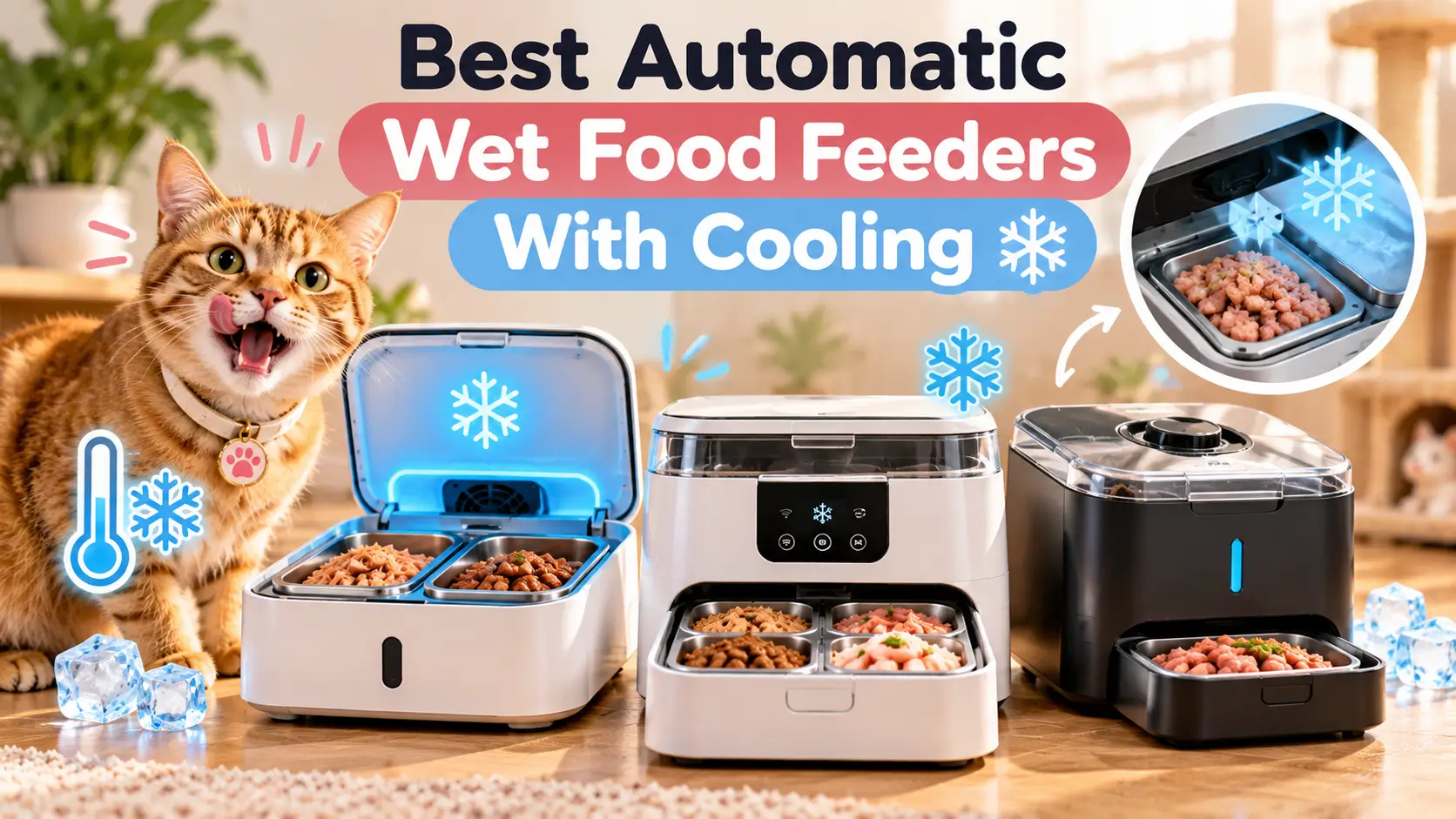
The best automatic wet food feeders with cooling include PetSafe FreshFeed for its manufacturer-stated 40°F refrigeration, PETLIBRO Polar for three scheduled meals with active cooling, and Cat Mate C500 for affordable ice-pack cooling. PetSafe is the strongest starting point for temperature-conscious buyers, but food safety still depends on verified temperatures, proper use, and maintenance.
Feeding dry kibble automatically is relatively straightforward. A motor turns, a measured portion falls into a bowl, and the feeder waits for the next scheduled meal.
Wet food is different.
Once a can or pouch is opened, the food becomes perishable. It needs appropriate temperature control, clean food-contact surfaces, and a sensible plan for handling leftovers.
That’s why buying an automatic wet food feeder involves a question that doesn’t apply in quite the same way to dry-food dispensers:
Will the food still be appropriately chilled when my cat’s next meal is due?
Many products promise to keep wet food fresh, but they use different technologies.
Some contain an active semiconductor cooling system. Others rely on reusable ice packs placed beneath a rotating tray. A few add features such as meal warming, smartphone alerts, or stainless steel bowls.
These differences can determine whether a feeder is appropriate for a scheduled meal later in the day—or whether its food-storage claims deserve more scrutiny.
This guide compares five real products from established or identifiable manufacturers, including their limitations.
You’ll learn which features matter, why active cooling isn’t automatically equivalent to refrigerator-safe storage, and how to choose a feeder without risking your cat’s meals.
Our Review Methodology: PetsVibe Tech evaluated manufacturer specifications, documented cooling behavior, meal capacity, scheduling controls, power requirements, food-contact materials, and cleaning procedures. We have not independently laboratory-tested these products. Manufacturer temperature and operating claims are identified as such, and we do not treat them as guarantees of safe food storage.
🏆 Quick Verdict: The Best Wet Food Feeders With Cooling
For buyers primarily concerned about holding prepared wet food at appropriate refrigerated temperatures, PetSafe FreshFeed Refrigerated Pet Feeder is our leading choice based on its published 40°F temperature specification and six-meal capacity.
For owners who value a connected three-meal system, PETLIBRO Polar Smart Wet Food Feeder is a notable option—but its published temperature performance requires particular attention before relying on extended storage.
For budget-conscious households feeding over shorter periods, Cat Mate C500 is a practical ice-pack alternative.
Best Wet Food Feeders Compared
| Product | Cooling System | Meal Capacity | Scheduling | Best For |
|---|---|---|---|---|
| PetSafe FreshFeed | Active thermoelectric refrigeration | 6 compartments | Smartphone app | Temperature-conscious scheduled feeding |
| PETLIBRO Polar | Active semiconductor cooling | 3 compartments | Smartphone app | Connected three-meal routines |
| UAHPET Fresh Food Feeder | Active cooling and warming | 2 bowls, up to 4 openings | On-device buttons | Cats that prefer warmed food |
| Cat Mate C500 | Two reusable ice packs | 5 compartments | Digital timer | Budget-friendly short-window feeding |
| Cat Mate C200 | Reusable ice pack | 2 compartments | Mechanical timers | Simple occasional meals |
Important: These devices are not equally capable of preserving perishable food. An ice pack is not a thermostat, and some active-cooling units publish temperatures above ordinary refrigeration guidance.
I Would Choose
- PetSafe FreshFeed when preserving chilled meals is the leading requirement, and its actual food temperature can be confirmed under home conditions.
- PETLIBRO Polar when I want a three-meal smart feeder and understand the limits of its temperature performance.
- UAHPET Fresh Food Feeder when serving temperature matters and I can supervise and validate the cooling routine.
- Cat Mate C500 for a shorter feeding schedule after verifying how long its ice packs keep food cold enough.
- Cat Mate C200 when I need only one or two simple timed openings rather than a complex app-controlled system.
I Would Not Choose
- An ice-pack feeder for multi-day wet-food storage without measured temperature evidence.
- A feeder solely because its manufacturer advertises several days of freshness.
- A cooling system that cannot reach an appropriate food-storage temperature for the intended holding period.
- A model without dependable power or a backup feeding arrangement.
- A wet-food feeder that my cat cannot comfortably approach or reliably access.
📖 In This Guide
1. Active Refrigeration vs Ice-Pack Cooling
2. The Best Automatic Wet Food Feeders Reviewed
3. Which Feeder Is Best for Your Situation?
4. How Long Can Wet Food Stay in an Automatic Feeder?
5. Features That Matter Before Buying
6. Daily Setup, Temperature Checks, and Cleaning
7. Common Buying Mistakes
8. Frequently Asked Questions
🧊 Active Refrigeration vs Ice-Pack Cooling: What’s the Difference?
This is the most important distinction in the entire buying guide.
The word cooling is used for different systems, but those systems don’t necessarily provide the same food-storage conditions.
Active Cooling: A Powered System That Removes Heat
Actively cooled feeders use electricity to reduce the temperature of the food-storage area.
Several models use thermoelectric, or semiconductor, cooling technology.
These systems typically combine a cooling element, heat transfer surfaces, ventilation, and electronic controls.
Their advantage is that cooling can continue while the device has power.
However, the actual temperature depends on the product’s design, operating environment, and the effectiveness of heat removal.
An active cooler is not automatically equivalent to a household refrigerator.
For example, one product may claim a temperature near 40°F, while another publishes a figure above 50°F.
Both use semiconductor cooling, but the food-storage implications are different.
Ice-Pack Cooling: A Finite Supply of Cold
An ice-pack feeder works differently.
You freeze reusable packs, place them beneath or near the food tray, and use a timer to expose the food at the scheduled meal.
The ice packs gradually absorb heat as they warm.
Once they lose their cooling capacity, the feeder cannot actively remove additional heat.
This means the food temperature changes over time.
The result depends on:
- Starting temperature of the food
- Size and number of ice packs
- Room temperature
- Insulation
- Time between loading and feeding
- Amount and positioning of food
- How often the feeder is opened
Two owners using the same feeder may get different results in different rooms.
The Food-Safety Difference
The U.S. Food and Drug Administration recommends promptly refrigerating or discarding unused canned and pouched pet food and setting refrigerators to 40°F (4.4°C) or below.
That provides a useful benchmark when assessing storage claims.
A feeder marketed as refrigerated should therefore be evaluated by its actual food temperature, not merely by whether its tray feels cool to the touch.
| Question | Active Cooling | Ice Packs |
|---|---|---|
| Does it actively remove heat? | Yes, while powered | No |
| Does it require electricity for cooling? | Yes | No during use |
| Can it maintain a target temperature? | Potentially, depending on design | Not continuously controlled |
| Does performance depend on room temperature? | Yes | Yes |
| Is temperature verification important? | Yes | Yes |
| Suitable for extended unattended storage? | Only with demonstrated safe conditions | Not without confirming cold-holding duration |
The key takeaway: Choose based on demonstrated food-temperature control—not on whether the box says refrigerated, chilled, or fresh.
🥇 PetSafe FreshFeed Refrigerated Pet Feeder — Best Overall for Temperature-Conscious Buyers
The PetSafe FreshFeed is our leading option because its manufacturer publishes a clear temperature target aligned with ordinary refrigeration guidance.
It uses dual semiconductor cooling and insulation to help keep prepared wet or fresh food at approximately 40°F when operated according to instructions.
It also offers more meal compartments than the other actively cooled feeders in this comparison.
Key Specifications
| Feature | PetSafe FreshFeed |
|---|---|
| Cooling | Active dual-semiconductor refrigeration |
| Manufacturer-stated holding temperature | 40°F (4.4°C) |
| Meal compartments | 6 |
| Total food capacity | Approximately 4.5 cups |
| Controls | PetSafe Pet Companion app |
| Subscription | Not required for normal feeder/app use |
| Food-contact accessories | Removable stainless steel inserts |
| Stainless inserts | Dishwasher-safe |
| Power | Wall outlet |
| Recommended room temperature | 60–85°F (16–29°C) |
Why It Ranks First
PetSafe’s published temperature specification is unusually relevant in this category.
Instead of simply describing food as cool, the manufacturer claims a refrigerated temperature of 40°F when the product is used correctly.
That doesn’t constitute independent laboratory verification.
But it gives buyers a measurable target against which performance can be checked.
The six-compartment rotating tray is also useful for cats receiving several measured meals.
One compartment is available initially, while the remaining compartments can be presented according to the programmed schedule.
A Useful Detail: The Stainless Steel Insert Setting
PetSafe’s support instructions say the app has a specific setting for whether the stainless steel food-tray inserts are being used.
That setting helps the feeder adjust cooling behavior for the selected tray configuration.
This is important because a difference in food-contact components can affect heat transfer.
If you use the inserts, configure the feeder accordingly.
Don’t assume that a visually small accessory change has no effect on temperature performance.
What We Like
- Published refrigeration target of 40°F
- Six pre-portioned compartments
- App-based scheduling
- No required app subscription
- Removable stainless steel inserts
- Adjustable feeder height
- Locking design that limits unauthorized access
- Manufacturer documentation for cleaning and temperature troubleshooting
Where It Falls Short
PetSafe FreshFeed isn’t a completely maintenance-free refrigerator.
Its cooling system depends on correct placement and ventilation.
PetSafe specifically warns against use in rooms outside its stated 60–85°F operating range.
The support instructions also require keeping vents clear and cleaning the air-intake filters.
You must still prepare meals, clean the tray, and check actual food conditions.
It also requires continuous electrical power for cooling.
Who Should Buy It?
This is a strong fit for:
- Cats eating several measured wet-food meals
- Owners needing app-based meal scheduling
- Households prioritizing a published refrigeration-temperature target
- Owners prepared to monitor cooling performance
- Cats eating veterinarian-approved prepared diets
PetsVibe Verdict: Best overall on documented refrigeration specifications, meal capacity, and scheduling convenience. Confirm actual performance in your home before relying on extended unattended storage.
🥈 PETLIBRO Polar Smart Wet Food Feeder — Best for Connected Three-Meal Scheduling
The PETLIBRO Polar is one of the most recognizable active-cooling wet-food feeders.
It uses semiconductor cooling, a rotating three-compartment tray, and the PETLIBRO app for scheduling.
Unlike an ice-pack feeder, it actively cools its food compartments while connected to electrical power.
Its stainless steel tray option makes cleaning more convenient.
However, there is an important qualification that buyers should understand before choosing it.
Key Specifications
| Feature | PETLIBRO Polar |
|---|---|
| Model | PLAF109 |
| Cooling | Active semiconductor cooling |
| Meal compartments | 3 |
| Capacity per compartment | Approximately 200 ml |
| Scheduling | PETLIBRO app |
| Wi-Fi | 2.4 GHz |
| Power | Wall adapter |
| Backup batteries | 3 AA batteries for supported feeding functions |
| Tray option | Dishwasher-safe stainless steel |
| Advertised storage period | Up to 72 hours under manufacturer conditions |
The Temperature Issue Most Buyers Should Know
PETLIBRO advertises that Polar can keep three prepared meals cool for up to three days.
But its official FAQ also describes laboratory performance of approximately 54°F (12°C) when the room temperature is 77°F (25°C).
That temperature is substantially above the FDA’s recommended refrigerator setting of 40°F or below.
PETLIBRO’s other product materials describe cooler results under different conditions, illustrating how ambient temperature and testing assumptions can affect performance.
These claims should not be interpreted as independent proof that perishable wet food remains safely refrigerated for three days.
The device may help slow warming and preserve palatability compared with an uncovered bowl.
But slowing warming is not identical to verified refrigerator-safe storage.
How the Feeding System Works
You prepare up to three meals in the rotating tray.
The app controls when the appropriate compartment becomes available.
PETLIBRO pauses cooling before a scheduled meal so that food is not served at its coldest temperature.
The feeder also includes a lid design intended to limit unwanted access and reduce the risk of pinching.
A Critical Power-Outage Detail
Polar supports AA backup batteries for limited feeding functionality during a power interruption.
However, the backup batteries should not be treated as a substitute for mains-powered refrigeration.
If wall power fails, the feeding schedule may continue for a supported period while active cooling becomes unavailable.
That matters far more with wet food than with ordinary dry kibble.
If the unit loses its ability to keep food adequately chilled, evaluate the food’s temperature and storage history before serving it.
What We Like
- Active cooling rather than passive ice packs
- Three scheduled compartments
- Connected app controls
- Removable stainless steel bowl option
- Anti-pinch lid safeguards
- Food access controlled by the rotating mechanism
- Convenient preparation of multiple portions
Limitations to Consider
- Published cooling performance varies with conditions.
- A stated 54°F result is above standard refrigeration guidance.
- Only three compartments are available.
- Cooling requires wall power.
- Connected setup adds complexity.
- Condensation may require regular cleaning.
- The tray’s physical height may not suit every small kitten or mobility-impaired cat.
Who Should Buy It?
Consider Polar if you want connected, pre-portioned wet-food scheduling and understand that its cooling claims need careful interpretation.
I would not choose it solely on the assumption that opened wet food can safely remain inside it for 72 hours.
PetsVibe Verdict: A feature-rich three-meal scheduling system, but not our first recommendation when verified refrigerator-temperature storage is the primary requirement.
🌡️ UAHPET Fresh Food Automatic Pet Feeder — Best for Cooling and Warming Features
The UAHPET Fresh Food Automatic Pet Feeder uses a different approach.
It combines thermoelectric cooling with a warming function designed to make prepared meals more appealing before serving.
Its two stainless steel bowls can be scheduled independently.
Unlike many app-controlled systems, the feeder uses built-in buttons to manage its schedule.
Key Specifications
| Feature | UAHPET Fresh Food Feeder |
|---|---|
| Model | UWSQ03 |
| Cooling technology | Thermoelectric |
| Advertised cooling range | 37.4–44.6°F (3–7°C) |
| Advertised warming range | 78.8–104°F (26–40°C) |
| Food bowls | 2 |
| Capacity per bowl | 330 ml |
| Scheduled openings | Up to 4 across the two bowls |
| Meal-access window | Approximately 20 minutes |
| Controls | On-device buttons |
| Power | 12V DC / 3A adapter |
| Food bowls | Removable stainless steel |
Why It’s Different
The standout feature is the combination of cooling and pre-meal warming.
Some cats prefer wet food when it is less cold.
UAHPET begins warming before a scheduled opening and closes the lid after the preset access window.
The system then resumes its cooling routine.
This design attempts to balance food storage with palatability.
Four Openings Don’t Mean Four Separate Portions
The product has two food bowls.
Each bowl can be opened at up to two scheduled times.
That creates as many as four feeding opportunities, but it doesn’t create four independently stored meals.
This distinction matters if you’re calculating how much prepared food can be scheduled.
The Cooling Limitation
UAHPET publishes a cooling range of 37.4–44.6°F.
The upper end is above the FDA’s recommended refrigerator temperature.
The manufacturer also notes that actual food temperature varies with room conditions and portion size.
Consequently, the cooling system should not be assumed to hold every meal at 40°F or below throughout the storage period.
The warming function introduces an additional consideration: food intentionally becomes warmer before being served.
If the cat doesn’t eat it, you need a safe leftover-handling plan rather than assuming repeated chilling and warming can continue indefinitely.
What We Like
- Both cooling and warming functions
- Two independently scheduled bowls
- Stainless steel food-contact surfaces
- No mandatory app
- Defined meal-access window
- Useful for cats that dislike very cold food
- Manufacturer-published temperature ranges
Limitations
- Only two physical food portions can be loaded.
- Warming requires careful attention to food holding time.
- The advertised cooling range is not always at or below 40°F.
- Actual food temperature varies.
- Mains electricity is required.
- A fixed 20-minute opening may not suit every slow eater.
Who Should Buy It?
Consider UAHPET if serving-temperature flexibility is especially important, you can validate the food’s cooling conditions, and you want a relatively simple control system.
PetsVibe Verdict: Best for warming convenience, with the important condition that temperature performance and leftover handling must be verified before relying on unattended wet-food storage.
🧊 Cat Mate C500 Automatic Feeder — Best Ice-Pack Option for Multiple Meals
The Cat Mate C500, sold through Closer Pets, is a familiar alternative to electronically refrigerated feeders.
Instead of using active cooling, it relies on two reusable ice packs positioned beneath a rotating food tray.
A digital timer advances the tray to reveal meals.
This approach offers a simpler and generally less expensive way to schedule food.
But it has an important limitation: the ice packs can’t hold a constant temperature indefinitely.
Key Specifications
| Feature | Cat Mate C500 |
|---|---|
| Cooling | Two reusable ice packs |
| Total compartments | 5 |
| Future scheduled openings | Up to 4 after the initially available compartment |
| Food compatibility | Wet or dry |
| Capacity per compartment | Approximately 330 g |
| Schedule | Digital timer |
| App needed | No |
| Continuous mains power | Not required |
| Cleaning | Removable food-contact tray components |
Why It’s Worth Considering
The C500 is useful for owners who don’t need smartphone connectivity or complex electronics.
You prepare the portions, freeze the supplied ice packs in advance, set the timer, and allow the feeder to expose meals as scheduled.
For a short absence, this may be enough when you have established that the food remains appropriately chilled.
What the Ice Packs Actually Do
The packs absorb heat as they warm.
They can help delay food reaching room temperature, but they don’t actively regulate food temperature.
A cool room may produce a very different result from a warm kitchen.
The manufacturer does not establish one universally safe cold-holding duration for every situation.
That means the number of scheduled meals should not be confused with a guaranteed number of hours of safe wet-food storage.
What We Like
- Five food compartments
- Simple digital timer
- No app or Wi-Fi dependency
- Reusable cooling packs
- Relatively straightforward cleaning
- Suitable for wet and dry food
- Lower complexity than actively cooled smart feeders
What Could Be Better?
The absence of active temperature control is the main weakness.
You need to freeze the ice packs before use and replace or refreeze them regularly.
The food’s temperature can rise as the packs warm.
The feeder is therefore more appropriate for verified short-duration use than for assuming several days of safe wet-food storage.
Who Should Buy It?
Consider C500 if:
- You want multiple scheduled portions.
- You prefer a device without Wi-Fi.
- You can test the cooling performance in your home.
- You only need to cover a limited feeding period.
- You want a simpler option than a refrigerated smart feeder.
PetsVibe Verdict: Best practical multi-meal ice-pack alternative, provided the feeding window is based on measured food temperature rather than the timer’s maximum schedule.
💰 Cat Mate C200 Automatic Feeder — Best Simple Two-Meal Option
Not every cat owner needs five or six compartments.
Sometimes the goal is much simpler.
You want your cat to receive breakfast while you’re sleeping or one additional meal during a short absence.
The Cat Mate C200 is designed for that kind of routine.
It includes two individually timed compartments and an ice pack beneath the bowls.
Key Specifications
| Feature | Cat Mate C200 |
|---|---|
| Cooling | Reusable ice pack |
| Compartments | 2 |
| Timers | Mechanical 48-hour timers |
| Food compatibility | Wet and dry |
| Approximate bowl capacity | 400 g per bowl in current product listing |
| Power | AA battery |
| App | Not required |
| Cleaning | Removable bowls and lids |
Why Choose a Mechanical Feeder?
The C200 avoids many of the complexities of smart feeding equipment.
You don’t need to connect it to a router.
There is no smartphone application to configure.
You set the timer and load the prepared food.
For occasional short absences, that’s appealing.
The Timing Trade-Off
Mechanical timers are generally less precise than digital scheduling systems.
Closer Pets acknowledges that analog timer operation may result in openings several minutes earlier or later than the selected time.
This may be acceptable for a healthy cat with a flexible feeding routine.
It may not suit a veterinary feeding plan that requires more precise timing.
Cooling Limitations
Like the C500, the C200 relies on ice packs.
Its 48-hour timer capability does not mean wet food is necessarily safe to store inside it for 48 hours.
Food temperature must be considered separately.
What We Like
- Simple setup
- Two separately timed lids
- No Wi-Fi dependency
- Removable ice pack
- Easy-to-clean components
- Suitable for owners needing only a couple of meals
Limitations
- No active refrigeration
- Mechanical timers have limited precision
- Only two compartments
- Ice-pack performance depends on the environment
- No connected monitoring or remote alerts
PetsVibe Verdict: Best simple, low-complexity option for short feeding windows, especially when a full smart refrigeration system would be unnecessary.
⚖️ Which Automatic Wet Food Feeder Should You Choose?
Instead of choosing the product with the most features, start with your main requirement.
| Your Situation | Best Starting Option | Why |
|---|---|---|
| Need measured refrigerated-temperature performance | PetSafe FreshFeed | Published 40°F target |
| Need six prepared meals | PetSafe FreshFeed | Six compartments |
| Want three scheduled meals and PETLIBRO app controls | PETLIBRO Polar | Connected three-meal system |
| Cat prefers food warmed before serving | UAHPET Fresh Food Feeder | Warming function |
| Need several timed meals without Wi-Fi | Cat Mate C500 | Digital timer and five compartments |
| Need just one or two additional meals | Cat Mate C200 | Simple mechanical operation |
| Feed prescription wet food | Temperature-verified setup approved for the diet | Storage requirements take priority |
| Two cats eat different diets | Separate protected feeding arrangements | Meal timing alone doesn’t prevent stealing |
| Need feeding during power outages | Verified backup plan with safe food handling | Backup movement doesn’t guarantee cooling |
For a Cat That Eats Small Meals Frequently
A six-compartment feeder may be more practical than one with only two or three sections.
But confirm that its food capacity and storage conditions fit your cat’s nutritional plan.
For a Cat That Eats Only Wet Food
Prioritize temperature control, hygiene, dependable scheduling, and appropriate serving capacity.
A conventional automatic kibble feeder is not a substitute.
For Two Cats With Different Diets
A rotating tray usually controls when a compartment opens.
It does not necessarily control which cat eats the food.
If one cat regularly steals the other’s meal, additional separation may be required.
Our guide How to Feed Two Cats Different Diets Without Food Stealing explains practical feeding-room setups and selective-access alternatives.
🩺 How Long Can Wet Cat Food Stay in an Automatic Feeder?
This question is more important than the advertised meal count.
Opened wet food should be handled as a perishable product.
The FDA recommends promptly refrigerating or discarding unused canned and pouched pet food, with refrigerators set to 40°F or below.
Don’t Confuse Three Different Times
Storage time: How long food remains chilled before its compartment opens.
Serving time: How long the food remains accessible at room or warmer temperatures.
Total elapsed time: How long the food has been out of appropriate refrigeration, including loading, warming, interruptions, and leftovers.
A feeder that holds food in a closed compartment for several hours doesn’t automatically provide safe refrigeration during that period.
What If the Feeder Runs at 54°F?
Food at 54°F is cooler than typical room temperature.
But it is warmer than the FDA’s recommended refrigerator setting.
That is why PETLIBRO’s published Polar temperature deserves attention.
The manufacturer may describe the device as extending freshness, yet the documented temperature does not match a standard refrigerator.
For prolonged storage, use only conditions that meet appropriate food-safety requirements.
What About Ice Packs?
No reliable universal answer exists, such as “all ice packs keep wet food safe for eight hours.”
The result depends on the feeder, the food, and the surrounding temperature.
The practical method is to test your setup using a food thermometer and a comparable portion under realistic conditions.
If the food rises above the required cold-holding temperature and the storage history becomes uncertain, don’t assume it remains safe just because the compartment is closed.
What About Raw Food?
Raw pet diets present additional microbial risks.
Do not assume that a feeder advertised for fresh or raw diets eliminates those risks.
Discuss an appropriate food-handling plan with your veterinarian and follow relevant safety guidance.
A refrigeration claim does not remove the need for careful hygiene.
The Safest Rule
When you cannot establish that perishable food has been stored appropriately, discard it rather than serving it.
A scheduled meal is not worth the risk of feeding potentially spoiled food.
🛒 What to Look for Before Buying a Wet Food Feeder
The following checklist is designed to prevent expensive mistakes.
1. Actual Food Temperature
Ask the most important question first:
What temperature does the food reach and maintain?
Prefer clear, documented measurements over vague claims about freshness.
2. Cooling Technology
Determine whether the feeder uses:
- Active refrigeration
- Less powerful active cooling
- Ice packs
- No cooling at all
Those descriptions should not be treated as interchangeable.
3. Number of Independently Stored Meals
A product offering four opening times may contain only two food bowls.
Count actual food compartments, not merely programmed events.
4. Power Dependence
Active refrigeration generally requires continuous electricity.
Check what happens when power fails.
5. Backup-Battery Function
Some devices can rotate a tray or preserve a schedule during an outage without continuing refrigeration.
Always distinguish between feeding backup and cooling backup.
6. Food-Contact Materials
Look for removable, cleanable bowls and trays.
Stainless steel can simplify some cleaning tasks, but construction and access still matter.
7. Ventilation and Room Temperature
Thermoelectric cooling systems release heat.
Blocked vents or high surrounding temperatures can reduce performance.
Review the manufacturer’s recommended operating environment.
8. Schedule Reliability
Determine whether the feeder requires Wi-Fi to follow existing schedules or only for remote configuration.
Test actual meal delivery, not just the app notification.
9. Portion Capacity
Confirm each compartment fits your cat’s prescribed meal.
Don’t assume total feeder capacity is equivalent to the amount available at one feeding.
10. Replacement Parts and Support
Check whether you can obtain replacement bowls, ice packs, power adapters, and other relevant components.
A device that’s difficult to maintain may be a poor long-term choice.
🌡️ How to Verify the Cooling Performance of Your Feeder
You don’t need a complicated laboratory setup to identify an obvious temperature problem.
A basic food-temperature check can help you decide whether the feeder behaves as advertised in your home.
However, a home test cannot validate every possible condition or certify food safety.
Step 1. Follow the Manufacturer’s Setup Instructions
Install the correct trays, inserts, cooling packs, and power supply.
Place the feeder in its intended location.
Keep all vents unobstructed.
Step 2. Start With Appropriately Chilled Food
Don’t use an automatic feeder to compensate for food that has already been left at room temperature too long.
Prepare food using normal safe-handling practices.
Step 3. Use a Food Thermometer
Check the food’s actual temperature at appropriate intervals.
The temperature of the outside casing is not a reliable substitute.
Step 4. Repeat Under Realistic Conditions
Test in the room where you intend to use the feeder.
Consider the longest waiting period you expect before a meal opens.
Step 5. Check Different Compartments
Temperature can vary across the tray.
Don’t assume one reading accurately describes every compartment.
Step 6. Check the Food at Serving Time
If the device pauses cooling or begins warming before opening, the serving temperature may differ from the earlier storage temperature.
That difference matters.
Step 7. Record Problems
If temperatures exceed suitable storage conditions, shorten the feeding interval, change the arrangement, or choose a more appropriate system.
Don’t rely on marketing language to override your actual findings.
🧼 How to Clean an Automatic Wet Food Feeder Properly
Wet food leaves residue that can collect in tray edges, lids, and moving mechanisms.
A good cleaning routine helps prevent odor, contamination, and mechanical problems.
After Each Feeding Cycle
Remove uneaten food.
Wash the removable bowl or tray components according to the manual.
Rinse and dry food-contact surfaces appropriately.
Do not allow old residue to accumulate.
Before Refilling
Check for:
- Food trapped beneath the tray
- Condensation
- Residue around the lid
- Obstructed rotating mechanisms
- Dirty seals
- Blocked cooling vents
- Unusual odors
For Actively Cooled Models
Follow the manufacturer’s cleaning and defrosting procedure.
Some devices require special treatment of their cooling plate, condensation area, or intake filters.
For example, PetSafe specifies regular cleaning of its air-intake filters because contamination can reduce cooling performance.
For Ice-Pack Models
Wash the food trays and check the condition of the reusable ice packs.
Freeze them fully according to their instructions.
Replace leaking or damaged packs.
What Not to Do
- Don’t immerse the electronic base unless explicitly permitted.
- Don’t clean a powered rotating mechanism.
- Don’t use harsh chemicals on food-contact surfaces.
- Don’t assume dishwasher safety applies to every component.
- Don’t reuse uneaten wet food when its safe storage conditions are uncertain.
A feeder with impressive technology still requires careful cleaning.
🐈 How to Introduce Your Cat to an Automatic Wet Food Feeder
Even an excellent feeder can fail if your cat refuses to eat from it.
Some cats are cautious about rotating trays, mechanical noises, and unfamiliar food temperatures.
Start gradually.
Step 1. Place It in a Familiar Feeding Area
Choose a quiet location away from competing pets.
Step 2. Begin With Familiar Food
Use the cat’s usual diet unless a veterinarian has instructed otherwise.
Avoid changing both the food and the feeder at the same time.
Step 3. Let Your Cat Eat Without Movement
When the product’s instructions permit, allow the cat to become comfortable with the stationary food tray before introducing scheduled rotation.
Step 4. Introduce a Supervised Feeding Cycle
Observe the mechanism opening or rotating.
Let your cat approach voluntarily.
Step 5. Watch for Food-Temperature Preferences
Some cats dislike very cold food.
Others are less sensitive.
Adjust the routine within the product’s supported settings without compromising appropriate food storage.
Step 6. Confirm Actual Eating
A successful app notification or completed tray rotation does not prove the cat consumed the meal.
Observe what remains.
Step 7. Keep a Backup Feeding Option
Until your cat accepts the feeder and it operates reliably, maintain a supervised alternative.
❌ Seven Mistakes to Avoid With Refrigerated Wet Food Feeders
1. Assuming All Active Cooling Is Refrigerator-Safe
Thermoelectric cooling systems can have different temperature capabilities.
Check documented and measured conditions.
2. Treating Ice Packs as Multi-Day Refrigeration
Ice packs warm as they absorb heat.
A timer’s maximum duration doesn’t establish safe food storage.
3. Ignoring Room Temperature
A feeder may perform differently in a hot room than in a cool, climate-controlled space.
4. Confusing Battery Backup With Cooling Backup
A device may continue presenting meals after losing wall power while no longer cooling its contents.
5. Counting Scheduled Openings as Separate Meals
Some products reuse the same bowl for multiple openings.
Check how many independently prepared portions the device actually stores.
6. Ignoring Leftovers
Food that has been served and exposed to room temperature needs appropriate handling.
Do not repeatedly re-chill leftovers without considering food safety.
7. Leaving a Cat Completely Dependent on an Untested Feeder
A new device can fail because of setup mistakes, power interruptions, mechanical faults, or an unwilling pet.
Test it under supervision before relying on it.
For PETLIBRO owners experiencing tray or lid problems, see PETLIBRO Feeder Not Dispensing Food? Model-Specific Fixes.
❓ Frequently Asked Questions
1. What is the best automatic wet food feeder with cooling?
PetSafe FreshFeed is our leading recommendation based on its manufacturer-stated 40°F refrigeration and six-meal capacity. PETLIBRO Polar offers connected three-meal scheduling, while Cat Mate C500 is a simpler ice-pack alternative for carefully verified shorter feeding periods.
2. Do automatic wet food feeders actually refrigerate food?
Some do. PetSafe FreshFeed uses active refrigeration and publishes a 40°F temperature target. Other products use semiconductor cooling that may operate at higher temperatures. Ice-pack feeders do not provide actively controlled refrigeration.
3. How long can wet cat food stay in a refrigerated automatic feeder?
It depends on the actual food temperature, the specific product, and the food’s storage instructions. A manufacturer’s advertised multi-day freshness period is not by itself proof of safe storage. Refrigerated leftover pet food should be kept at 40°F or below according to FDA guidance.
4. Is PETLIBRO Polar a real refrigerated feeder?
It uses active semiconductor cooling. However, PETLIBRO’s published laboratory figure of approximately 54°F at a 77°F room temperature is above standard refrigerator guidance. Do not assume it provides the same storage conditions as a household refrigerator.
5. Are automatic wet food feeders with ice packs safe?
They may be useful for limited periods when the actual food temperature is appropriately controlled. Ice-pack performance varies with room temperature, starting conditions, and elapsed time. A closed lid and frozen ice pack do not independently guarantee safe storage.
6. Which wet food feeder holds the most meals?
Among the products compared here, PetSafe FreshFeed has six compartments. Cat Mate C500 has five, PETLIBRO Polar has three, and UAHPET and C200 have two physical bowls.
7. Can I leave wet food in an automatic feeder overnight?
Only if appropriate food-storage conditions can be maintained and verified for the intended period. A feeder without active refrigeration should not be assumed safe for overnight wet-food storage simply because it contains an ice pack.
8. Does a refrigerated automatic cat feeder work during a power outage?
Usually, active cooling depends on mains electricity. Some devices have batteries for scheduling or tray movement, but those batteries may not power refrigeration. Check the exact backup functions and follow safe food-handling practices after outages.
9. Can two cats share one automatic wet food feeder?
They may be able to use one feeder if they share a suitable diet and feeding routine. But most rotating wet-food feeders do not identify which cat eats each meal. Cats with different diets may need separate protected stations.
10. Can I put prescription wet food in an automatic feeder?
Some models accept prescription canned food. However, the appropriate storage temperature and feeding schedule depend on the diet and the cat’s medical needs. Follow the food manufacturer’s instructions and your veterinarian’s guidance.
11. Do refrigerated wet food feeders require a subscription?
Not necessarily. PetSafe states that FreshFeed and its companion app do not require a subscription for normal use. Other brands may have different connected-service arrangements. Check the exact device and feature list.
12. Is a stainless steel tray better for wet food?
Stainless steel can be durable and convenient to clean, particularly when the tray is removable and dishwasher-safe. However, material choice alone doesn’t guarantee hygiene. Proper cleaning and food-temperature control remain essential.
✅ Final Verdict: Which Wet Food Feeder Is Worth Buying?
The best automatic wet food feeders with cooling are not necessarily the products advertising the longest freshness period or the most connected features.
The first question should always be whether the device can maintain appropriate food-storage conditions.
Based on published specifications, PetSafe FreshFeed Refrigerated Pet Feeder is the strongest starting point for buyers who prioritize refrigerated wet-food storage. Its stated 40°F performance, six compartments, and clear maintenance instructions make its claims more directly assessable.
PETLIBRO Polar offers convenient connected scheduling, but its documented cooling temperatures mean buyers should be cautious about treating its advertised three-day storage period as proof of food safety.
UAHPET Fresh Food Feeder adds an interesting warming feature, although its temperature range and repeated bowl-opening behavior require careful food handling.
For simpler, shorter feeding routines, Cat Mate C500 and C200 provide alternatives that don’t depend on smartphone connectivity. Their ice packs, however, should never be treated as a guaranteed substitute for refrigeration.
Before buying any model, check the cooling specifications, power requirements, food capacity, cleaning process, and suitability for your cat’s diet.
Then validate the setup under real conditions before relying on it when you’re away.
The best feeder does more than open at the right time. It helps you serve the right food, under appropriate storage conditions, in a way your cat can reliably use.