
💡 Quick Answer
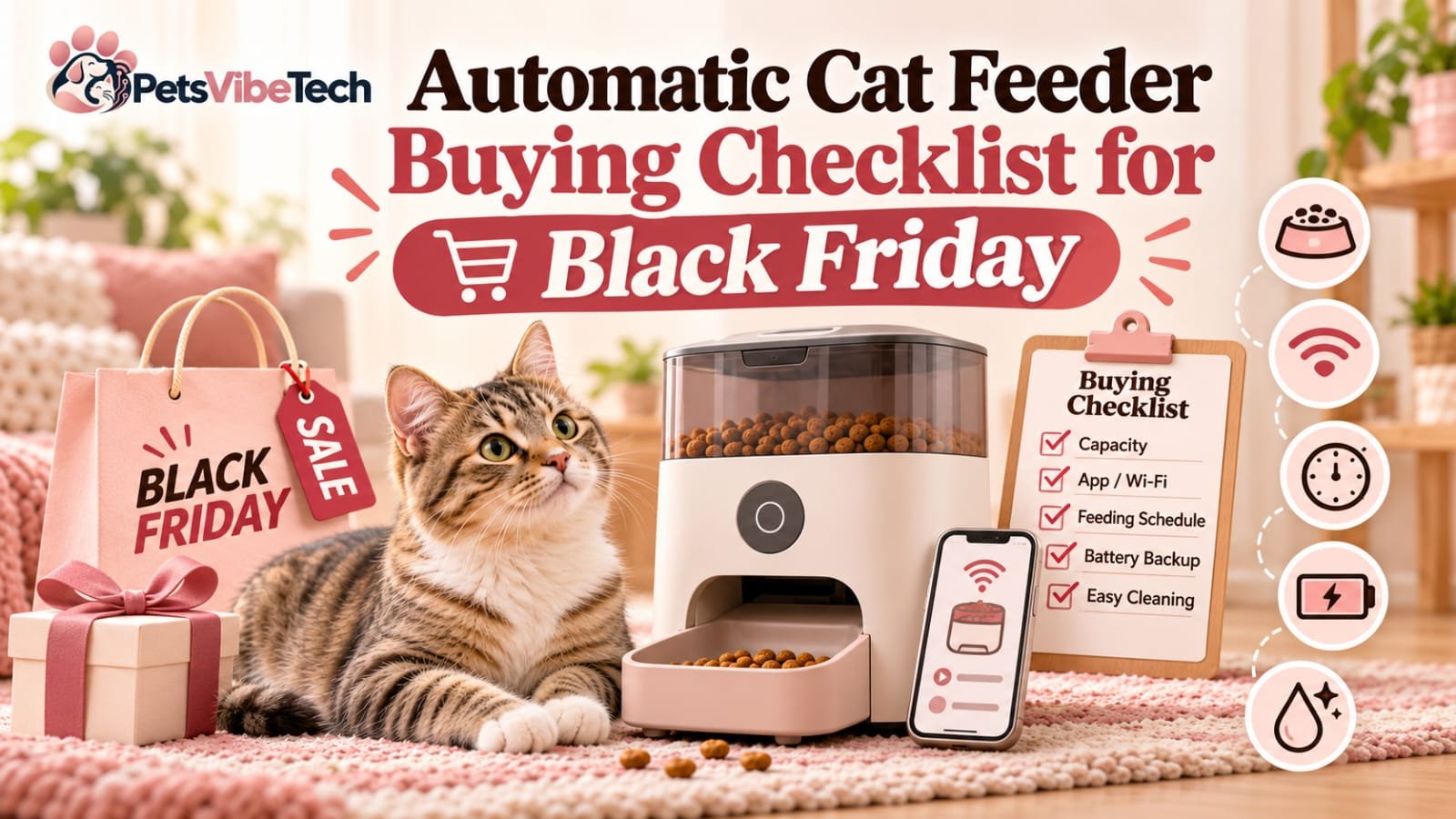
This automatic cat feeder buying checklist covers the features that matter most on Black Friday: accurate portions, compatibility with your cat’s food, dependable scheduling, backup power, easy cleaning, and a sensible return policy. Before purchasing, compare the exact model’s recent selling price—not just the advertised discount—and make sure it solves your actual feeding problem.
Check prices on Amazon: PETLIBRO Granary Smart Feeder · PetSafe Healthy Pet Simply Feed
Related guide: Best Automatic Cat Feeders That Work Without Wi-Fi
A discounted automatic feeder can look like an easy decision. It promises regular meals, fewer early-morning wake-ups, and one less thing to worry about when you’re out.
But there’s a detail product listings rarely emphasize: a feeder can have an impressive app, a camera, and a large food container while still being a poor match for your cat.
Perhaps your kibble is too large for the dispensing mechanism. Maybe you have two cats, and the greedy one eats both portions. Or the feeder switches off its Wi-Fi features during a power outage, leaving you wondering whether dinner was served.
None of those problems disappears because the price is 40% lower.
Before Black Friday, spend a few minutes answering the questions below. You’ll have a much better idea of which features deserve your money.
What Kind of Feeder Do You Actually Need?
Start with your cat’s routine, not the product’s feature list.
| Your Situation | What to Look For |
|---|---|
| One cat eating dry kibble | Basic programmable feeder with adjustable portions |
| Unreliable home internet | Feeder with local scheduling that works offline |
| Frequent power outages | Reliable battery backup and documented outage behavior |
| Two cats stealing each other’s food | Selective-access microchip or RFID solution |
| Cat eating wet food | Appropriate refrigerated or short-duration timed wet-food system |
| Need to monitor meals remotely | Smart feeder with useful status notifications |
| Cat needs carefully measured meals | Small, repeatable portions that you can verify by weight |
There’s no point paying extra for a camera if you don’t intend to use it. Equally, choosing the cheapest timer may be frustrating if you need to change feeding schedules while traveling.
The best choice is usually the simplest model that does the job reliably.
The 10-Point Automatic Cat Feeder Buying Checklist
1. Will It Dispense Your Cat’s Actual Food?
This is the first question I’d check, even before the price.
Most hopper-style automatic feeders are designed for dry kibble. They aren’t necessarily suitable for wet food, freeze-dried pieces, or unusually shaped pellets.
For example, PETLIBRO specifies a kibble diameter range of approximately 2–15 mm for certain Granary models.
Other feeders may have different limits.
Don’t assume a feeder works with your food simply because the product photograph shows ordinary-looking kibble.
Check the manufacturer’s stated size range and compare it with the food you use at home.
For wet food, look for a device specifically designed for it, with suitable food-temperature management.
Buying rule: If the manufacturer can’t clearly explain which foods the feeder supports, choose another model.
2. Can You Measure Portions Accurately?
A feeder may advertise 20 portion settings without explaining what one portion actually means.
Some machines dispense by volume rather than weight.
That’s important because two types of kibble can occupy the same volume but weigh different amounts.
Suppose your cat needs a carefully controlled daily food allowance. You don’t want to guess how many grams the feeder delivers.
Look for a model that allows small portion adjustments.
Once it arrives, use a kitchen scale to weigh several test servings and calculate the average amount dispensed.
Then adjust the schedule according to your cat’s feeding plan.
For cats on medically prescribed diets, follow your veterinarian’s feeding instructions.
Buying rule: More portion settings aren’t automatically better. Repeatability matters more.
3. What Happens During a Power Outage?
Battery backup is one of the most useful features in an automatic feeder.
But the phrase can be misleading.
With some models, backup batteries maintain scheduled meals while Wi-Fi, cameras, or other electronics become unavailable.
For example, certain PETLIBRO Granary feeders continue scheduled dispensing during battery-only operation but disable Wi-Fi functionality.
Other models have different backup capabilities.
Before buying, find out:
- Whether scheduled meals continue during an outage
- Which battery type the feeder uses
- Whether batteries are included
- Which functions stop working on backup power
- Whether the schedule remains saved after a restart
For a detailed explanation, read our Automatic Cat Feeder Battery Backup guide.
Buying rule: Prioritize continued feeding over optional connected features.
4. Does It Need Wi-Fi to Feed Your Cat?
An app-controlled feeder can be convenient.
You might adjust a schedule while you’re away or receive notifications when food is running low.
However, a good feeder shouldn’t leave your cat without scheduled meals merely because the internet connection drops.
Check whether feeding schedules are stored locally and continue when Wi-Fi is unavailable.
Also verify the required network frequency. Some products support only 2.4GHz Wi-Fi, while others support 5GHz as well.
If you rarely change feeding times remotely, a non-Wi-Fi feeder may be perfectly adequate.
Our Best Automatic Cat Feeders That Work Without Wi-Fi guide compares this option in more detail.
Buying rule: Wi-Fi is a convenience, not a substitute for dependable dispensing.
5. Will It Work in a Multi-Cat Home?
This is where many buyers choose the wrong device.
A feeder with two bowls doesn’t necessarily provide two independent meals.
If both bowls share one dispenser, a faster cat may still eat most of the food.
For households where cats need separate diets, a selective-access feeder may be more appropriate.
Some models identify a registered microchip or RFID tag before allowing access.
One important distinction: a selective-access feeder isn’t always a programmable timed feeder.
The SureFeed Microchip Pet Feeder, for example, controls food access rather than automatically dispensing scheduled portions.
If food stealing is the problem, see our Best Cat Feeders for Cats That Steal Food guide.
Buying rule: Separate bowls and separate food access are not the same feature.
6. How Difficult Is It to Clean?
A feeder sits in contact with food every day. Crumbs, oils, and moisture can collect in places that aren’t immediately visible.
Look beyond the product’s glossy exterior.
Check whether you can remove the bowl, food tank, dispensing components, and other food-contact parts for cleaning.
Stainless steel bowls are often convenient, but don’t assume every component is dishwasher-safe.
Check the manufacturer’s instructions.
Also consider where the feeder will sit. A model that barely fits beneath a kitchen cabinet might be awkward to refill.
Buying rule: If cleaning looks complicated in the product manual, expect it to become annoying after purchase.
7. Is the Food Container Practical?
Large capacity sounds attractive, but bigger isn’t always better.
A huge hopper may encourage you to leave kibble inside longer than intended, particularly if you have one cat eating small portions.
The FDA recommends keeping dry pet food in a cool, dry environment and retaining the original bag or its identifying information for traceability.
For feeder use, check how securely the lid closes, whether moisture can enter, and how easily you can empty and clean the container.
If the model uses replaceable desiccant packs, include them in your ongoing costs.
Buying rule: Choose enough capacity for your routine, not simply the largest container available.
8. Are the Alerts Actually Useful?
Some smart feeders offer feeding records, low-food notifications, and alerts about dispensing problems.
Those features can be helpful, especially when you’re at work.
But don’t confuse an app notification with independent proof that your cat has eaten.
A feeding record may tell you the machine attempted a scheduled dispensing cycle. It doesn’t necessarily confirm how much food reached the bowl or whether your cat consumed it.
Consider which alerts you’ll genuinely use.
A built-in camera might be worthwhile if visual checking matters to you. Otherwise, you may be paying extra for a feature you already have through a separate indoor camera.
9. Can You Replace Parts and Get Support?
Before purchasing, search for replacement bowls, food tanks, power adapters, and any model-specific accessories.
Check the warranty duration and whether the seller is authorized.
It’s also worth looking at the manufacturer’s troubleshooting instructions.
A feeder with accessible support documentation is easier to live with when something goes wrong.
Many dispensing problems come down to food size, buildup, incorrect assembly, or power issues. Our Automatic Cat Feeder Not Dispensing Food guide covers those common causes.
Buying rule: A modest discount isn’t attractive if a broken part makes the entire feeder unusable.
10. Is the Black Friday Discount Genuine?
Don’t begin with the percentage shown on the product page.
Begin with the price the exact model usually sells for.
Consider this hypothetical example:
| Price | Amount |
|---|---|
| Advertised original price | $150 |
| Typical recent selling price | $110 |
| Black Friday price | $90 |
| Advertised discount | 40% |
| Saving against recent price | About 18% |
The sale may still be worthwhile, but it’s a different deal from the one suggested by the discount badge.
Compare price-history information where available, then check reputable retailers for the same model number.
The Federal Trade Commission also recommends reviewing shipping charges, return policies, and the complete conditions of online offers.
Be cautious with sellers offering unusually steep discounts on unfamiliar models.
Buying rule: A genuine saving is measured against a realistic selling price, not merely a crossed-out reference price.
Which Features Are Worth Paying Extra For?
Not every upgrade offers equal value.
| Feature | Priority | Why |
|---|---|---|
| Reliable scheduling | Essential | The feeder’s main job |
| Consistent portion dispensing | Essential | Supports an appropriate feeding routine |
| Compatible kibble size | Essential | Reduces the risk of dispensing problems |
| Easy cleaning | Essential | Matters every day |
| Battery backup | High | Helps during short outages |
| Wi-Fi and app control | Optional | Convenient for remote changes |
| Camera | Optional | Useful if you need visual monitoring |
| Voice recording | Low for most owners | Not necessary for dispensing |
| RFID or microchip access | Situation-dependent | Valuable for food stealing and separate diets |
I would generally choose a dependable feeder with straightforward controls over a more elaborate model with features I won’t use.
That’s especially true if the cheaper device has better cleaning access and reliable offline operation.
A Five-Minute Check Before Checkout
Keep this checklist open while comparing Black Friday offers.
- My cat’s food type and kibble size are compatible.
- The feeder supports the meal schedule I need.
- I can adjust and verify portion sizes.
- I understand what happens without electricity or Wi-Fi.
- The bowl and food-contact parts are easy to clean.
- The design suits the number of cats in my home.
- Replacement parts and support are available.
- I’ve checked whether subscriptions or consumables add costs.
- The exact model is genuinely cheaper than usual.
- I’ve checked the warranty, shipping costs, and return policy.
If an essential answer is missing, don’t let a countdown timer rush you.
What to Do During the First Week After Buying
A feeder should earn your trust before you rely on it.
Start by washing and assembling the removable parts according to the manual.
Next, load the kibble your cat normally eats and test multiple dispensing cycles.
Weigh the portions. Try the scheduled feeding function. If the manufacturer supports it, simulate a Wi-Fi disconnection and test battery-backup behavior.
Then observe your cat using the feeder for several days.
Watch for unexpected noise, food getting stuck, bowl movement, or attempts to access the hopper.
Don’t make a new feeder your cat’s only food source during a long absence until you’ve confirmed that it works consistently.
And even with a dependable feeder, arrange appropriate human care when you’re away. A machine cannot recognize every illness or emergency.
Feeders that pass this checklist
- PETLIBRO Granary Smart Feeder — schedules stored locally, battery backup. Amazon
- PetSafe Healthy Pet Simply Feed — no Wi-Fi needed for scheduled meals. Amazon
- SureFeed Microchip Pet Feeder — for multi-cat homes and food stealing. Amazon
- WOPET automatic feeders — Wi-Fi and app-controlled models from the brand store. WOPET store
Affiliate links: we may earn a commission at no extra cost to you. Prices change, so check the listing before you buy.
Frequently Asked Questions
Is Black Friday a good time to buy an automatic cat feeder?
It can be. Established models sometimes receive worthwhile discounts, but you should compare the exact product’s recent price and confirm that it meets your needs before buying.
Should I choose a Wi-Fi or non-Wi-Fi automatic cat feeder?
Choose Wi-Fi if remote schedule changes and notifications matter to you. A non-Wi-Fi model may be simpler and sufficient if you only need dependable scheduled meals.
Do automatic cat feeders work during power outages?
Some have backup batteries that preserve feeding schedules. Other functions, including Wi-Fi connectivity, may stop. Check the behavior of the exact model before purchasing.
Can one automatic feeder feed two cats?
Yes, but two bowls don’t guarantee that each cat receives the intended amount. If food stealing or different diets are concerns, consider selective-access feeding.
Can I put wet cat food in a regular automatic feeder?
Not unless the feeder is specifically designed to handle it safely. Ordinary dry-food hopper feeders are generally unsuitable for wet food. Wet food requires appropriate time and temperature management.
How do I know whether an automatic feeder’s portions are accurate?
Dispense several test portions into a bowl, weigh them with a kitchen scale, and compare the results. Repeat the test when changing kibble types, because portion weight may differ.
Final Verdict
Black Friday is a good opportunity to purchase an automatic feeder you’ve already researched. It’s a poor time to gamble on a model simply because its price looks irresistible.
For most single-cat households using dry food, I’d prioritize consistent portions, reliable scheduling, battery backup, and easy cleaning.
For households with unreliable internet, offline operation deserves more attention than app features.
And for cats that steal food or need different diets, access control matters much more than the number of bowls.
Use this automatic cat feeder buying checklist to narrow your options before looking at discounts.
The right feeder should make daily care easier—not create another piece of equipment you’re constantly troubleshooting.




Share your experience