
💡 Quick Answer
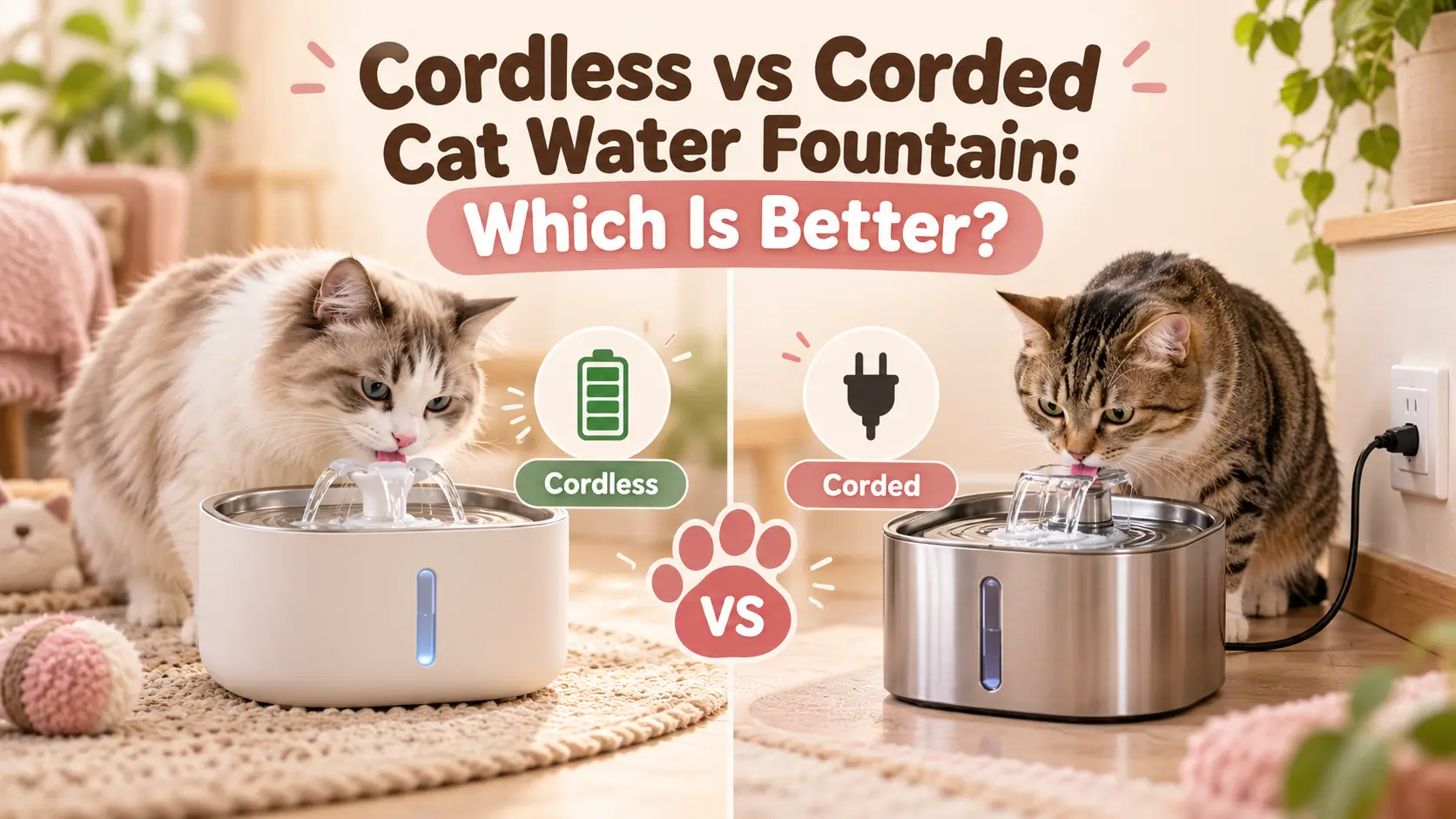
In the cordless vs corded cat water fountain comparison, choose cordless if you need flexible placement, fewer exposed cables, or battery operation during an outage. Choose corded if you want dependable continuous water flow without recharging. Neither is inherently healthier: the better fountain is the one your cat uses consistently, and you can maintain properly.
A cordless cat water fountain sounds like an obvious upgrade.
No power cable running across the floor. No need to place your cat’s water beside an electrical outlet. Just fill the reservoir, charge the battery, and position the fountain wherever your cat feels comfortable.
But there’s a trade-off that product descriptions don’t always make clear.
Many rechargeable fountains don’t circulate water continuously while running on battery power. Instead, they activate when a cat approaches or circulate at intervals to conserve energy.
For some cats, that works perfectly.
Others are attracted to the sight and sound of constantly running water. A fountain that stays still until they approach may not encourage the same drinking behavior.
Traditional plug-in fountains have the opposite strengths and weaknesses. They can provide uninterrupted flow while electricity is available, but their placement is restricted by the cord and outlet.
So which type is actually better?
The answer depends on four things:
- Where you want to place the fountain.
- Whether your cat prefers continuous or occasional water movement.
- How reliably you can keep the fountain powered.
- How much maintenance you’re willing to manage.
This guide compares both designs, explains the hidden limitations, and uses real PETLIBRO models to show why the difference matters before you buy.
How We Evaluated This Comparison
This guide is based on manufacturer-documented operating modes and established veterinary hydration guidance. We compared power requirements, water availability, circulation behavior, maintenance, safety considerations, and everyday suitability.
PetsVibe Tech has not independently tested the products mentioned. We do not present manufacturer battery estimates as verified real-world results.
🏆 Quick Verdict: Cordless vs Corded Cat Water Fountains
For a typical home with a conveniently located outlet, a corded fountain is often the simpler choice. It avoids charging interruptions and can maintain continuous water flow on models that support that mode.
A cordless fountain is more useful when placement freedom matters, particularly if your cat prefers a quiet location far from outlets.
A dual-power cordless model can offer the most flexibility—but only if its battery-mode behavior meets your expectations.
At-a-Glance Comparison
| Feature | Cordless Fountain | Corded Fountain |
|---|---|---|
| Power source | Rechargeable battery, sometimes wall power too | Wall outlet |
| Placement flexibility | Excellent | Limited by cable length |
| Continuous flow | Model- and power-mode-dependent | Commonly available |
| Motion activation | Available on many models | Depends on model |
| Charging required | Yes | No battery charging for normal use |
| Power outage | May continue operating on battery | Pump normally stops |
| Purchase complexity | Battery and operating modes to consider | Generally simpler |
| Battery aging | Relevant | Not applicable to plug-in-only models |
| Exposed power cord | Avoidable during cordless use | Required |
| Ongoing cleaning | Required | Required |
| Best for | Flexible indoor placement | Predictable continuous operation |
I Would Choose Cordless If…
- My cat’s preferred drinking spot is far from an outlet.
- I want to avoid a cable in a busy walkway.
- I need a fountain that can operate during a short power interruption.
- I prefer motion-triggered water flow.
- I’m comfortable checking battery levels and charging the device.
I Would Choose Corded If…
- A safe outlet is already near the ideal water station.
- My cat prefers constantly moving water.
- I don’t want to manage charging.
- I want a straightforward fountain for daily use.
- I prefer fewer battery-related components.
My recommendation: Don’t pay extra for cordless operation unless you will actually benefit from the freedom it provides.
📖 In This Guide
1. How Cordless and Corded Fountains Work
2. The Seven Differences That Matter
3. PETLIBRO Dockstream 2: A Real Model Comparison
4. Which Fountain Fits Your Cat?
5. Battery Life, Electricity, and Ownership Costs
6. Water Hygiene and Maintenance
7. A Practical Buying Checklist
8. Frequently Asked Questions
🔌 How Do Cordless and Corded Cat Water Fountains Work?
Both types use a pump to move water through a drinking system.
In many designs, water travels from the reservoir through a filter or circulation pathway before returning to the drinking area.
The main difference is how the pump receives power.
How a Corded Cat Water Fountain Works
A corded fountain connects to an electrical outlet through a compatible power adapter.
The pump operates while power is available, according to the fountain’s selected mode.
Many conventional models circulate water continuously.
Others allow intermittent schedules through built-in controls or an app.
The main advantage: You don’t need to recharge a battery.
The main limitation: The fountain must remain within safe reach of a power outlet.
If electricity fails, a plug-in-only fountain normally stops pumping.
Depending on its design, some water may remain accessible in the drinking tray, but you should not assume every model provides a usable supply without electricity.
How a Cordless Cat Water Fountain Works
A cordless fountain contains a rechargeable battery that can operate the pump without a permanent connection to an electrical outlet.
Some models also work when plugged in.
To preserve battery life, many cordless fountains use motion activation or timed circulation instead of running constantly.
For example, a motion-activated fountain may start pumping when a cat approaches, then stop after a preset interval.
This reduces pump operating time.
However, it also changes what your cat experiences.
Instead of approaching an already-flowing stream, the cat may need to trigger the fountain before the water moves.
Cordless Doesn’t Mean Maintenance-Free
A rechargeable fountain still needs:
- Charging
- Fresh water
- Regular cleaning
- Filter replacement
- Pump inspection
- Battery condition monitoring
Removing the power cable does not remove these responsibilities.
What About a “Wireless Pump”?
This is an important buying distinction.
Some fountains advertise wireless pump technology because the pump uses an induction-based power connection.
But the fountain’s base may still require a continuous connection to an outlet.
A wireless pump is not necessarily a cordless fountain.
Before buying, look for an explicit rechargeable battery specification and confirmation that the complete device operates unplugged.
⚖️ Seven Important Differences Between Cordless and Corded Fountains
1. Placement Flexibility: Cordless Wins
Imagine your cat prefers drinking from a quiet corner beside a bedroom window.
Unfortunately, the nearest outlet is several feet away.
A corded fountain may require an inconvenient cable across the floor or a different location entirely.
A cordless fountain avoids that restriction.
You can place it:
- In a quiet corner of the living room
- Near a favorite resting location
- In a suitable area away from heavy foot traffic
- In a room without a conveniently positioned outlet
- At another accessible drinking station in a multi-cat home
This flexibility is particularly useful when your cat avoids busy areas.
Why Placement Matters
Cats may have individual preferences about where they drink.
Some prefer water away from food or litter boxes.
Others choose locations where they can observe their surroundings without feeling trapped.
In multi-cat homes, one cat may also avoid a water station if another regularly blocks access.
A cordless fountain lets you prioritize the cat’s preferred environment rather than the electrical layout.
When Corded Is Just as Good
If the best drinking location already has a suitable outlet nearby, a corded fountain may be equally convenient.
In that case, cordless operation might provide little additional value.
Winner: Cordless—but only when you need flexible placement.
2. Water Flow: Corded Usually Has the Advantage
This is where the comparison becomes more interesting.
A fountain’s water-flow pattern may influence whether your cat wants to use it.
Some cats are attracted to a visible stream of moving water.
Others are comfortable drinking from a still or gently circulating surface.
Corded Fountains and Continuous Flow
Many plug-in fountains can circulate water continuously.
That creates a predictable drinking experience.
When the cat approaches, the stream is already running.
The pump doesn’t need to wait for a sensor to detect movement.
Cordless Fountains and Intermittent Flow
Battery-powered fountains often limit pump activity.
Depending on the model, they may:
- Activate when a pet approaches
- Circulate at scheduled intervals
- Run periodically to move water
- Offer different modes when plugged in
A cat comfortable with motion-activated flow may adapt easily.
But a cat that only approaches when it hears running water might ignore a fountain that remains quiet until a nearby movement triggers it.
Does Intermittent Flow Mean Dirty Water?
Not automatically.
Cleanliness depends on water quality, contamination, circulation, filtration, and maintenance.
But remember that a conventional filter generally treats water when water is moving through it.
A fountain that circulates intermittently does not provide the same continuous filtration activity as one running all day.
That doesn’t prove one is hygienically superior under all conditions.
It means you should follow the device’s cleaning instructions rather than assuming occasional circulation keeps the reservoir permanently clean.
Winner: Corded for predictable continuous flow; either can work for cats comfortable with intermittent circulation.
3. Power Outages: Cordless Has a Practical Advantage
Suppose the electricity fails while you’re away.
A plug-in-only fountain stops operating its pump.
A cordless model with sufficient remaining battery power can continue working in a supported battery mode.
This can be a valuable backup.
However, battery-powered operation isn’t a guarantee of uninterrupted water access.
The device could have:
- An empty battery
- An obstructed pump
- A sensor problem
- A low water level
- A mechanical failure
A Better Backup Plan
Whether you use cordless or corded, provide an additional clean water bowl.
This gives your cat another source of drinking water if the fountain stops unexpectedly.
What If You Live in an Area With Frequent Outages?
A battery-powered fountain may provide more resilience.
But confirm that the model resumes operation automatically in the relevant mode.
Don’t assume that a plugged-in fountain has battery backup simply because it belongs to a product family that also includes a cordless version.
Winner: Cordless, provided the battery is charged and the selected mode continues operating.
4. Charging and Everyday Reliability: Corded Wins
Corded fountains eliminate one recurring task: battery charging.
For owners with busy schedules, that matters.
A plug-in fountain can continue operating without attention to a rechargeable battery, as long as the outlet, adapter, pump, and water supply remain functional.
Cordless fountains introduce an additional failure point.
What If You Forget to Charge the Battery?
The fountain may stop circulating water.
Some models warn you through an indicator or app notification.
Others may require a manual battery check.
The seriousness of the problem depends on whether your cat can still access water from the tray.
Don’t assume the device remains a functioning drinking station after the battery is exhausted.
Does a Cordless Fountain Always Need Frequent Charging?
No.
Battery life varies widely.
Manufacturers sometimes advertise several weeks of operation under particular conditions.
But a cat that activates the pump frequently may produce different battery performance.
The number of cats, operating mode, battery condition, and usage pattern all matter.
Winner: Corded for simplicity and freedom from charging routines.
5. Safety and Cable Management: It Depends
A cordless fountain removes the exposed power cable while it operates from battery power.
That’s useful in homes where cables create a tripping hazard or where pets are inclined to chew them.
However, cordless doesn’t automatically mean safer in every respect.
Corded Fountain Safety
A well-designed corded fountain can be used safely when installed correctly.
Check that:
- The adapter is appropriate for the device.
- Cables are protected from chewing.
- Electrical connections remain dry.
- The fountain sits on a stable surface.
- The cable doesn’t create a tripping hazard.
- The setup follows manufacturer instructions.
A drip loop, where recommended by the manufacturer, helps prevent water from traveling along the cable toward an electrical connection.
Cordless Fountain Safety
Battery-powered devices also require care.
Use approved charging equipment.
Do not charge a device with damaged contacts or a damaged battery.
Follow the manufacturer’s instructions for keeping charging components dry.
If the battery overheats, swells, or develops an unusual odor, stop using the device.
The Practical Difference
Cordless reduces some cable-related risks during battery operation.
Corded avoids dependence on a rechargeable battery.
Neither design should be considered inherently safer without evaluating the actual product and installation.
Winner: Depends on the home and device design.
6. Maintenance and Cleaning: Neither Wins Automatically
It’s tempting to assume a cordless fountain is easier to clean because it has fewer visible wires.
That isn’t necessarily true.
Cleaning difficulty depends more on the construction than the power source.
Consider two possible designs.
Fountain A: A corded model with an easily removable pump and smooth reservoir.
Fountain B: A cordless model with a complicated filter compartment and several narrow water channels.
Despite being corded, Fountain A may be faster to clean.
The reverse is also possible.
Features That Make Cleaning Easier
Look for:
- A removable water tank
- An accessible pump or rotor
- A drinking tray that can be washed thoroughly
- Few difficult-to-reach openings
- Clearly documented cleaning instructions
- Easily available replacement filters
Stainless Steel vs Plastic
The material of the drinking tray can influence cleaning convenience.
But a stainless steel tray doesn’t automatically mean the entire fountain is stainless steel.
Many models combine stainless steel drinking surfaces with plastic reservoirs and internal components.
Inspect the complete design.
How Often Should You Clean a Fountain?
Follow the manufacturer’s schedule and inspect the fountain frequently.
Replace drinking water regularly, wash accessible food-contact surfaces, and clean the pump according to instructions.
If the water looks cloudy, smells unusual, or contains visible debris, don’t wait for the next scheduled cleaning.
Winner: The model with the simpler cleaning design—not necessarily cordless or corded.
7. Long-Term Ownership Cost: Corded Often Has the Simpler Cost Structure
A cordless fountain may cost more initially because it includes a rechargeable battery and associated electronics.
But purchase prices vary, and some premium corded fountains also include expensive smart features.
Instead of assuming one type is cheaper, compare the full ownership cost.
| Expense | Cordless | Corded |
|---|---|---|
| Initial purchase | May include battery premium | Often simpler hardware |
| Replacement filters | Usually | Usually |
| Electricity | Charging and possibly plug-in use | Ongoing plug-in use |
| Battery aging | Relevant | No operating battery in plug-in-only designs |
| Replacement pump or parts | Possible | Possible |
| Charging accessories | May be needed | Not for normal operation |
| Cleaning supplies | Required | Required |
Is the Electricity Cost of a Corded Fountain High?
Many small fountains use relatively low-power pumps, but actual consumption varies.
You can estimate energy use with this formula:
Annual Electricity Use (kWh) = Power in Watts × Operating Hours per Day × 365 ÷ 1,000
For example, a hypothetical 2-watt pump operating continuously would use approximately 17.5 kWh over a year.
Multiply that figure by your local electricity tariff to estimate the energy cost.
This is an illustrative calculation, not a measured specification for any particular fountain.
In many purchasing decisions, replacement filters, build quality, and future repairs deserve at least as much attention as electricity consumption.
Winner: Corded for a generally simpler cost structure, although total cost depends on the specific model.
🧪 Real Product Comparison: PETLIBRO Dockstream 2 Cordless vs Plug-In
The PETLIBRO Dockstream 2 product family provides a useful real-world example because it includes two closely related fountains with different power requirements.
This makes it easier to isolate the differences that matter.
PETLIBRO Dockstream 2 Smart Cordless Fountain
The cordless version includes a rechargeable battery and a sensor that detects an approaching pet.
It can operate without a permanent power connection.
However, its available flow modes change depending on the power source.
On battery power: Pet-sensing flow only.
When plugged in: Continuous flow or pet-sensing flow.
That means the cordless model gives you both placement flexibility and the option of continuous operation when connected to an outlet.
But it doesn’t deliver continuous flow while relying solely on its battery.
The manufacturer advertises up to 30 days of battery life under specified sensor-mode conditions involving one pet.
That is an estimate, not a guaranteed runtime.
PETLIBRO Dockstream 2 Smart Fountain (Plug-In)
The plug-in version requires continuous electrical power through its adapter.
It does not have a built-in battery.
Its water-flow options include:
- Continuous flow
- Timed flow
Unlike the cordless version, it doesn’t include the pet-detection sensor.
Direct Feature Comparison
| Feature | Dockstream 2 Cordless | Dockstream 2 Plug-In |
|---|---|---|
| Built-in battery | Yes | No |
| Works without power cable | Yes | No |
| Continuous flow when plugged in | Yes | Yes |
| Continuous flow on battery | No | Not applicable |
| Pet-sensing flow | Yes | No |
| Timed flow | Mode-dependent; sensor timings adjustable | Yes |
| Smart app features | Yes | Yes |
| Water capacity | 3 liters | 3 liters |
| Best reason to buy | Flexible placement | Predictable plugged-in operation |
What This Example Reveals
The cordless model isn’t simply the plug-in model with the cable removed.
It has a different sensor system and different operating behavior.
That can make it more versatile, but only if those additional features are useful to you.
A Buying Mistake Worth Avoiding
Imagine you buy the cordless model specifically because your cat loves an uninterrupted water stream.
You put it on a shelf far from an outlet.
Then you discover that it only runs in pet-sensing mode on battery power.
The product isn’t defective.
It is operating as designed.
But it doesn’t match your expectation.
Always compare operating modes under battery power, not just the features shown in the product’s general specification list.
🐈 Which Fountain Is Better for Different Cats?
The right choice becomes clearer when you consider your cat’s behavior.
Scenario 1: A Cat That Loves Running Tap Water
Your cat waits beside the bathroom sink and tries to drink whenever you turn on the tap.
A continuously flowing fountain may be more immediately attractive because the water movement is always visible.
Better starting point: Corded fountain with continuous flow.
A cordless model can also work if it supports continuous flow in the location where you plan to use it.
Scenario 2: A Nervous Cat That Dislikes Sudden Movement
Some cats may be startled when a motion-triggered pump starts unexpectedly.
A predictable, gentle continuous stream may be easier for these cats to accept.
Other nervous cats may prefer a quiet, still drinking surface.
Better starting point: A fountain with adjustable flow behavior—or a familiar water bowl while testing preferences.
Scenario 3: A Cat That Avoids Busy Areas
Perhaps your cat drinks most comfortably in a quiet room with no nearby electrical outlet.
Placement freedom may be more important than constant water movement.
Better starting point: Cordless.
Scenario 4: Two Cats With Different Drinking Habits
One cat may approach a fountain frequently while the other prefers a regular bowl.
A shared fountain doesn’t automatically meet both preferences.
Provide multiple drinking locations and observe actual use.
Better starting point: Either type, supplemented by separate water stations.
Scenario 5: A Senior Cat With Limited Mobility
Accessibility matters more than whether the pump uses a cable or battery.
Consider:
- Low, comfortable drinking height
- Stable placement
- Clear access without jumping
- Minimal disturbance from other pets
- Easily accessible water even when the pump isn’t active
Better starting point: Whichever model offers the most accessible and reliable water station.
Scenario 6: An Owner Who Travels Frequently
If you’re away from home often, charging becomes an important responsibility.
A corded fountain avoids battery depletion during ordinary use, but it still needs water-level checks, cleaning, and protection from power failures.
A cordless fountain may offer battery backup, but only while sufficiently charged.
Better starting point: Choose based on the reliability of your complete care arrangement, not just the power source.
Neither fountain should replace regular checks on your cat.
💧 Is a Cordless or Corded Fountain Better for Cat Hydration?
A fountain’s power source does not determine how much water a cat drinks.
Individual behavior matters more.
Cornell University’s Feline Health Center notes that some cats drink more when provided with water fountains, while others have different preferences.
Cats also obtain water through food.
A cat eating moisture-rich wet food may drink less from a bowl than a cat eating mainly dry kibble.
Therefore, seeing less fountain use doesn’t automatically mean your cat is dehydrated.
What Actually Matters for Hydration?
Focus on:
- Consistent access to clean drinking water
- Comfortable drinking locations
- Food moisture content
- Individual drinking preferences
- Absence of competition around water
- Recognition of changes in drinking behavior
Does Continuous Flow Guarantee Better Hydration?
No.
A constant stream may encourage some cats to approach.
Others may prefer a quiet bowl.
There isn’t a sound basis for claiming that every cat will drink more simply because a fountain runs continuously.
Does Motion Activation Encourage Drinking?
It might encourage some cats by providing moving water when they approach.
But that depends on reliable sensor activation and the cat’s response to the movement.
A motion sensor detects an approaching pet; it does not necessarily confirm that the pet drank.
Important Medical Warning
If your cat suddenly drinks much more or much less than usual, consult a veterinarian.
Changes in thirst can accompany medical conditions such as kidney disease or diabetes.
Signs including weakness, lethargy, poor appetite, or unusually dry gums also deserve prompt attention.
A water fountain is a drinking accessory, not a medical treatment or substitute for veterinary care.
🔋 Understanding Cordless Battery-Life Claims
Cordless fountains frequently advertise battery endurance in days or weeks.
These claims can be useful, but they need context.
A manufacturer might measure battery life using:
- One pet
- A particular sensing mode
- A specific number of daily activations
- A fully charged new battery
- Controlled testing conditions
Your household may behave differently.
What Shortens Battery Life?
- Frequent sensor activation
- Longer water-flow intervals
- Multiple pets approaching
- Different pump modes
- Battery aging
- Environmental conditions
Battery Capacity Doesn’t Tell the Whole Story
Manufacturers may provide a battery capacity in milliamp-hours (mAh).
A larger number does not automatically guarantee longer operation across different fountain models.
Pump consumption, voltage, electronics, and sensor behavior also affect runtime.
Compare manufacturer’s endurance tests and operating conditions rather than judging by capacity alone.
What Should You Do Before Leaving a Cordless Fountain Unattended?
Check that:
- The battery is adequately charged.
- The pump activates properly.
- The water level is sufficient.
- The sensor isn’t obstructed.
- Your cat can comfortably access the water.
- A separate clean bowl is available.
If you regularly forget to recharge household devices, a plug-in fountain may be the more practical choice.
🧼 Cleaning: What Both Fountain Types Have in Common
Cordless and corded fountains circulate water.
Neither makes standing water sterile.
Filters can help capture debris and reduce certain impurities, but they do not replace cleaning.
Daily Checks
Inspect the fountain for:
- Low water
- Visible fur or debris
- Unusual smells
- Weak or absent flow
- Unusual pump noises
- Contamination of the drinking tray
Replace water regularly and keep a separate bowl clean.
Routine Deep Cleaning
Follow the manufacturer’s instructions for:
- Disconnecting power or safely disabling the device.
- Emptying the reservoir.
- Removing washable components.
- Cleaning the drinking tray and tank.
- Cleaning accessible pump components.
- Rinsing approved parts thoroughly.
- Replacing filters when due.
- Reassembling and testing the fountain.
Never immerse a charging base or electronic component unless its manual explicitly permits it.
Why Pump Access Matters
Hair, mineral deposits, and accumulated debris can reduce circulation.
Some pumps require their covers and impellers to be cleaned periodically.
If those parts are difficult to access, maintenance may become frustrating regardless of power type.
What If the Pump Stops Working?
Start with the basics:
- Is the power source functioning?
- Is the battery charged?
- Is the water level sufficient?
- Is the pump blocked?
- Is air trapped in the water pathway?
- Are all parts correctly assembled?
For a dedicated step-by-step troubleshooting guide, see:
Cat Water Fountain Pump Not Working? 9 Things to Check
This covers common water-flow failures, including blocked pumps and incorrect reassembly.
🛒 How to Choose Between Cordless and Corded: A Five-Minute Decision Test
Before purchasing, answer these questions.
Question 1: Where Will You Place the Fountain?
If the ideal location has a safe nearby outlet, both designs remain options.
If it doesn’t, cordless offers an advantage.
Question 2: Does Your Cat Need Constantly Moving Water?
If the cat reliably approaches only when water is visibly flowing, prioritize a model that supports continuous operation in your intended setup.
If the cat is comfortable with still water or intermittent circulation, a cordless sensor model may work.
Question 3: How Often Are You Willing to Charge It?
If you dislike charging another device, choose corded.
If you already have a dependable maintenance routine, a rechargeable fountain may not be inconvenient.
Question 4: What Happens During a Power Failure?
If outages are a concern, a battery-capable fountain offers an additional power option.
But keep fresh water available separately.
Question 5: Can You Clean the Fountain Easily?
Compare actual product designs.
If the reservoir and pump are difficult to clean, reconsider the purchase regardless of power type.
Decision Matrix
| Your Answer | Stronger Choice |
|---|---|
| I need freedom from outlet locations | Cordless |
| My cat prefers a visible constant stream | Corded or dual-power with continuous mode |
| I want no charging routine | Corded |
| I want battery operation during outages | Cordless |
| I want the simplest power setup | Corded |
| I want motion-activated water flow | Cordless model with sensor |
| I want a fountain for several drinking locations | Consider cordless, but also provide bowls |
| I care most about easy cleaning | Compare individual models |
| I want minimum long-term complexity | Usually corded |
| I want maximum placement flexibility | Cordless |
💰 Is It Worth Paying More for a Cordless Fountain?
A premium only makes sense when the extra features solve a real problem.
Suppose you have two options.
Option A: A corded fountain with a suitable capacity, easy cleaning, and continuous flow.
Option B: A more expensive cordless fountain with a rechargeable battery and motion sensor.
If the fountain will sit beside an outlet in the same location every day, Option B’s portability may provide little value.
But if your cat drinks best from a quiet location far from outlets, Option B may be more suitable.
The decision should reflect the benefit you actually receive.
Don’t Pay for Features You’ll Never Use
Some smart fountains offer:
- Drinking activity records
- App notifications
- Water-level alerts
- Filter reminders
- Motion activation
- Adjustable circulation modes
These can be useful, but they’re not equally valuable to every owner.
For example, a daily filter reminder doesn’t replace physically checking whether the water is clean.
And a drinking activity chart isn’t automatically a precise medical measurement of water consumed by each cat in a multi-cat household.
Consider Replacement Parts
Before choosing a model, check whether replacement filters, pumps, charging components, and other accessories are available.
A fountain that is inexpensive initially but difficult to maintain may become a poor long-term purchase.
🚫 Common Mistakes When Comparing Cordless and Corded Fountains
1. Assuming Every Cordless Fountain Provides Continuous Flow
Many use intermittent or motion-triggered circulation on battery power.
Check the actual battery operating mode.
2. Confusing a Wireless Pump With a Battery-Powered Fountain
A wireless pump may still depend on a corded base.
Look for a built-in battery and explicitly supported unplugged operation.
3. Assuming a Longer Battery Claim Means Cleaner Water
Battery endurance and hygiene are different considerations.
A fountain still needs regular cleaning and water replacement.
4. Buying Based Only on Reservoir Capacity
A three-liter tank doesn’t mean its water can be left untouched for several days.
Water can become contaminated even when the reservoir isn’t empty.
5. Ignoring Your Cat’s Drinking Preferences
Some cats enjoy running water.
Others dislike pump noise or unexpected movement.
Your cat’s actual behavior matters more than an advertised feature.
6. Assuming App Monitoring Replaces Observation
A smart fountain may record activity or estimate consumption.
But it cannot replace watching for changes in your cat’s health and behavior.
7. Using the Fountain as the Only Water Source
A second clean water bowl provides a simple backup if the fountain stops operating.
This is useful regardless of whether the fountain uses a battery or an outlet.
🔗 Recommended Next Read
If you decide that cordless is the better fit, our related buying guide examines actual rechargeable models and their motion sensors:
Best Cordless Cat Water Fountains With Motion Sensors (This Year)
It compares the PETLIBRO Dockstream models and PETKIT EVERSWEET MAX, with attention to battery endurance, water capacity, and smart features.
❓ Frequently Asked Questions
1. Is a cordless cat water fountain better than a corded one?
Not necessarily. Cordless fountains provide placement flexibility and battery operation. Corded fountains generally offer simpler power management and predictable continuous-flow options. The better choice depends on your cat’s preferences and your home.
2. Do cordless cat fountains run continuously?
Some support continuous flow when plugged in, but many operate intermittently or use motion sensors on battery power. Check the specific model’s operating modes.
3. How long does a cordless cat water fountain battery last?
Battery life varies by model and usage. Some manufacturers advertise several weeks of battery operation under defined conditions. Actual endurance depends on pump activity, sensor use, and battery condition.
4. Do corded cat water fountains use a lot of electricity?
Many use small pumps with relatively low electrical consumption. The actual cost depends on the fountain’s power rating, operating hours, and local electricity price.
5. Are cordless cat water fountains safer?
They eliminate an exposed operating cable when used on battery power, which can be helpful in some homes. However, rechargeable devices require proper battery and charging safety. Neither type is automatically safer in every situation.
6. Do cordless fountains keep water as clean as corded fountains?
Cleanliness depends on water quality, circulation, filtration, design, and maintenance. Cordless fountains may circulate intermittently, while many corded models operate continuously. Neither removes the need for regular cleaning.
7. What happens to a corded cat water fountain during a power outage?
The pump normally stops. Some water may remain accessible depending on the design, but this shouldn’t be assumed. Provide a separate clean drinking bowl as a backup.
8. Does PETLIBRO Dockstream 2 Cordless work without electricity?
It operates from its rechargeable battery without being connected to an outlet. However, battery operation supports pet-sensing flow rather than continuous flow. It still needs electricity for recharging.
9. Can a cordless cat fountain work for multiple cats?
Yes, provided its size, water access, maintenance routine, and sensor behavior suit the household. More frequent activations may affect battery life, and drinking records may not distinguish individual cats.
10. Which fountain is best for a cat that drinks very little?
Choose a drinking setup your cat willingly uses. Some cats prefer moving water, while others prefer ordinary bowls. Provide several clean water options and consult a veterinarian if drinking behavior changes or hydration is a concern.
✅ Final Verdict: Should You Buy a Cordless or Corded Cat Water Fountain?
The cordless vs corded cat water fountain decision isn’t about choosing a universally superior technology.
It’s about matching power delivery and water-flow behavior to your cat’s daily routine.
A corded fountain is often the more straightforward choice when you have a convenient outlet and want continuous circulation without worrying about charging.
A cordless fountain becomes attractive when location matters more than constant flow—particularly for cats that prefer drinking in quiet areas away from outlets.
A dual-power model can offer additional flexibility, but you must confirm what it does while running on battery.
The PETLIBRO Dockstream 2 comparison illustrates why this matters. Two fountains can look similar, offer many of the same smart features, and still have meaningfully different operating modes.
Don’t choose based on the word “wireless” alone.
Check the power requirements, test your cat’s reaction to the water flow, and choose a design you can clean and maintain consistently.
Most importantly, ensure your cat always has access to fresh drinking water—even when the fountain needs charging, cleaning, or repair.
The best cat water fountain is the one that fits your home, suits your cat’s preferences, and provides dependable access to clean water every day.