
💡 Quick Answer
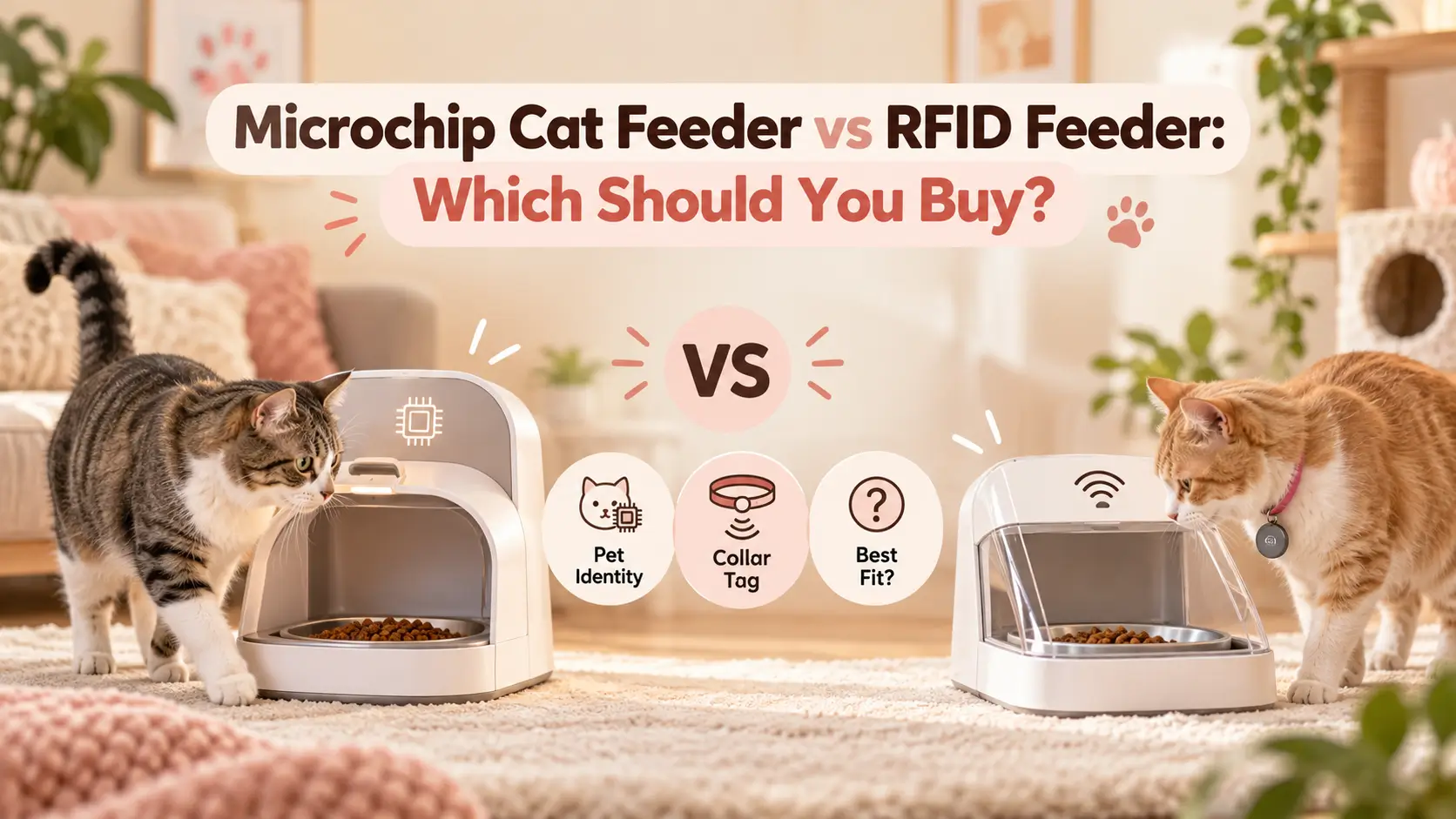
In the microchip cat feeder vs RFID feeder comparison, choose an implanted-microchip reader if your cat needs collar-free access to protected food. Choose a dedicated RFID collar-tag feeder if you want features such as automatic dry-food scheduling. Both use radio-frequency identification; the meaningful differences are tag compatibility, feeding functions, and how access is controlled.
Picture this: You have two cats.
One eats slowly, returning to its bowl several times throughout the day. The other finishes breakfast almost immediately and heads straight for the remaining food.
You’ve tried moving the bowls apart. You’ve tried different feeding times. But whenever you’re not watching, the faster cat finds a way to steal the other one’s meal.
A selective-access feeder seems like an obvious solution—until you start shopping.
One product promises to recognize your cat’s implanted microchip. Another advertises RFID identification, smartphone scheduling, and automated portions.
Both claim to help prevent food stealing, but they don’t necessarily work the same way.
The difference matters because choosing the wrong system can leave you with an expensive feeder that doesn’t support your cat’s existing microchip, can’t dispense the type of food you use, or requires a collar your cat refuses to wear.
This guide goes beyond basic product specifications to explain what actually changes at mealtime, where each design falls short, and how to choose the right setup for a multi-cat household.
Our evaluation approach: This comparison uses manufacturer-published technical specifications and an analysis of everyday feeding requirements. We have not independently tested these products. Recommendations reflect documented capabilities, not claims of firsthand performance or comparative reliability.
⚖️ Quick Verdict: Microchip vs RFID Cat Feeders
For most owners whose primary problem is food stealing, an implanted-microchip feeder such as the SureFeed Microchip Pet Feeder is a strong starting point. It controls access to a prepared bowl without requiring a collar, provided the cat has a compatible implanted chip.
If you also want scheduled dry-food dispensing, the PETLIBRO One RFID Smart Feeder offers more automation, but it recognizes only its dedicated collar tag—not an implanted identification microchip.
| Decision Factor | Implanted-Microchip Feeder | RFID Collar-Tag Feeder |
|---|---|---|
| Identification | Reads a compatible chip under the cat’s skin | Reads a compatible external tag |
| Collar required | No, if the implanted chip is recognized | Yes, for collar-tag-only models |
| Automatic meal scheduling | Depends on the product; standard SureFeed doesn’t dispense meals | Available on models such as PETLIBRO One |
| Wet food compatibility | Standard SureFeed supports wet and dry food | PETLIBRO One supports dry food only |
| Food theft protection | Controls access to a prepared bowl | Controls access to an assigned feeding station |
| Portion dispensing | Standard SureFeed requires manual filling | PETLIBRO One dispenses programmed dry-food portions |
| Internet requirement | Standard SureFeed doesn’t need Wi-Fi | PETLIBRO One uses app and Wi-Fi setup |
| Main limitation | No automatic replenishment | Requires the dedicated collar tag |
I Would Choose a Microchip Feeder If…
- My cat already has a compatible implanted microchip.
- The cat dislikes or frequently loses collars.
- I need to protect wet food or a special diet.
- My cat eats small amounts over several visits.
- I prefer a simple device without app-based scheduling.
I Would Choose an RFID Collar-Tag Feeder If…
- My cat comfortably wears a breakaway collar.
- I want dry food dispensed at scheduled times.
- Different cats need individually controlled portions.
- I value app-based scheduling and feeding records.
- I’m prepared to maintain separate feeding stations where needed.
The deciding question isn’t which identification technology sounds more advanced. It’s whether you need to protect food you’ve already served or automatically prepare portions throughout the day.
📖 In This Guide
1. The Real Difference Between Microchip and RFID Technology
2. How Each Feeder Controls Food Access
3. SureFeed vs PETLIBRO: A Practical Product Comparison
4. Which System Works Best for Different Cats?
5. Hidden Limitations and Ownership Costs
6. How to Set Up Feeding Stations in Multi-Cat Homes
7. A Buying Checklist Before You Decide
8. Frequently Asked Questions
🔍 Microchip vs RFID: Are They Actually Different Technologies?
Here’s something that many product comparisons overlook:
An implanted pet identification microchip is itself a type of RFID device.
RFID stands for Radio-Frequency Identification.
The technology allows a reader to identify a compatible electronic transponder using radio signals.
In the pet-feeder market, however, manufacturers often use the terms differently:
- Microchip feeder usually describes a device that reads an identification chip implanted beneath the pet’s skin.
- RFID feeder often describes a device that reads a separate electronic tag worn on the pet’s collar.
So the distinction isn’t really RFID versus non-RFID.
It’s implanted identification versus external identification.
How Does an Implanted Microchip Feeder Work?
A cat’s identification microchip contains an electronic identifier.
When a compatible reader detects that microchip, it can recognize the registered cat.
In a selective-access feeder, this identification controls a moving lid.
The process generally follows four steps:
- The cat approaches the feeder.
- The reader detects its compatible implanted microchip.
- The feeder checks whether that identity has been authorized.
- If authorized, the lid opens to provide food access.
When the cat moves away, the lid closes according to the device’s operating settings.
The important advantage is that the cat doesn’t need to carry a separate collar tag.
How Does an RFID Collar-Tag Feeder Work?
A collar-tag system also uses electronic identification.
But instead of reading an implanted chip, it recognizes a compatible tag attached to the cat’s collar.
For example, the PETLIBRO One RFID system uses a dedicated collar tag and a reader mat.
When the authorized tag is detected, the feeder allows the designated cat to access its food.
Its separate dispensing mechanism can also release programmed portions from the hopper.
This creates two functions:
Identity control: Which cat can reach the food?
Meal control: When and how much food is dispensed?
Those are separate capabilities, even when a product combines them.
Does the RFID Tag Need Charging?
Not necessarily.
PETLIBRO states that the dedicated tag supplied with its One RFID feeder does not require charging.
Its identification system should not be confused with a GPS tracker or battery-powered smart collar.
The feeder still needs electricity for its own operation.
Can Any RFID Feeder Read Any Microchip?
No.
RFID is a family of identification technologies, not a universal compatibility guarantee.
A feeder must support the appropriate identifier and reader system.
For example:
- SureFeed supports common implanted identification microchips and compatible SureFlap collar tags.
- PETLIBRO One RFID works with its own dedicated collar tag.
- PETLIBRO One RFID does not recognize implanted microchips or unrelated RFID tags.
Buying mistake to avoid: Never assume a product can recognize your cat’s veterinary identification chip merely because its name contains “RFID.”
🐈 How Do Microchip and RFID Feeders Prevent Food Stealing?
Both systems attempt to protect food by restricting access to an authorized pet.
But their success depends on more than recognition accuracy.
The physical bowl design, opening mechanism, placement, and behavior of other cats all matter.
Microchip Feeders: Protecting Food Already in the Bowl
Consider a cat that prefers grazing.
You place its morning food in a SureFeed Microchip Pet Feeder.
When the authorized cat approaches, the lid opens.
After the cat leaves, the feeder closes, reducing opportunities for another pet to reach the remaining food.
This works with the cat’s natural eating rhythm.
The feeder doesn’t need to dispense additional kibble because the meal has already been prepared.
For a slow eater in a multi-cat household, that may be exactly what’s needed.
RFID Feeders: Combining Food Access With Meal Scheduling
Now imagine a different household.
Two cats receive measured servings of dry food at different times.
The owner wants each cat’s meal released automatically rather than manually filling several bowls.
A device such as PETLIBRO One RFID can dispense scheduled portions while controlling access through a dedicated tag.
That makes it potentially more convenient for owners who are away during normal feeding hours.
However, the convenience comes with additional setup, including collar compatibility, app configuration, and food-dispensing maintenance.
The Limitation Both Systems Share
Neither technology creates a completely theft-proof environment.
A determined cat may attempt to follow another into an open feeder.
Another cat might intimidate the authorized pet into leaving its meal unfinished.
Physical protection and household behavior are separate problems.
A selective feeder can control access to a bowl, but it cannot automatically resolve every form of food competition.
For a closer look at feeding arrangements and food-stealing solutions, read our guide:
Best Cat Feeders for Cats That Steal Food (This Year)
⭐ SureFeed Microchip Pet Feeder vs PETLIBRO One RFID: Product Comparison
Two useful examples demonstrate how these approaches differ in practice.
SureFeed Microchip Pet Feeder — Best for Collar-Free Food Protection
SureFeed is designed primarily around protecting a bowl from unauthorized pets.
The standard model recognizes compatible implanted microchips as well as SureFlap RFID collar tags.
It supports both wet and dry food.
You fill the bowl yourself, and the device controls who can access it.
Key Specifications
| Feature | SureFeed Microchip Pet Feeder |
|---|---|
| Identification | Compatible implanted microchip or SureFlap tag |
| Food compatibility | Wet and dry |
| Bowl capacity | 400 ml |
| Authorized identities | Up to 32 |
| Scheduled dispensing | No |
| App required | No |
| Power | Four C-cell batteries |
| Training mode | Yes |
Where SureFeed Makes the Most Sense
Its biggest advantage is straightforward selective access without requiring an existing microchipped cat to wear a collar.
That is useful when one cat needs a diet that another cat shouldn’t eat.
It also suits cats that return to their bowls throughout the day.
The protected bowl helps limit unauthorized access between visits.
What Are the Trade-Offs?
You still need to prepare and refill meals.
The standard SureFeed doesn’t release fresh kibble at scheduled times.
It also cannot ensure that a cat finishes its food.
And while it supports up to 32 registered identities, all authorized pets gain access to the same bowl.
Registering several cats does not create separately controlled portions for each one.
When Would I Choose It?
I would prioritize SureFeed when the problem is unauthorized access to an existing meal, especially if the intended cat eats wet food, grazes slowly, or doesn’t wear a collar.
PETLIBRO One RFID — Best for Scheduled Dry-Food Access
PETLIBRO One RFID adds automatic food dispensing to selective access.
Instead of manually filling a protected bowl every time, you can create a feeding schedule through the app.
The feeder releases dry kibble into its food bowl and uses its identification system to restrict access.
Key Specifications
| Feature | PETLIBRO One RFID |
|---|---|
| Model | PLAF301 |
| Identification | Dedicated RFID collar tag |
| Implanted microchip reader | No |
| Food compatibility | Dry kibble only |
| Kibble size | 2–15 mm |
| Food tank capacity | 3 liters |
| Scheduling | Up to 10 meals or snacks daily |
| Tag pairing | One dedicated tag per feeder |
| Connectivity | 2.4 GHz / 5 GHz Wi-Fi |
| Backup power | Three alkaline D batteries |
Where PETLIBRO Makes the Most Sense
Consider a household where each cat needs scheduled dry-food portions.
The owner wants food dispensed automatically while limiting which cat can approach the assigned feeding station.
PETLIBRO combines these functions in one device.
This can reduce the need to manually prepare each meal.
What Are the Trade-Offs?
The cat must wear the dedicated RFID tag to be recognized.
The product does not support implanted identification microchips.
It also doesn’t dispense wet food.
Because each feeder pairs with one dedicated tag, owners who need separate automatic feeding for multiple cats may require multiple units.
That can significantly affect the total cost.
A Detail Worth Knowing Before Installation
PETLIBRO recommends placing multiple One RFID feeders at least 10 inches (about 25 cm) apart to reduce potential interference.
Its reader mat must also be correctly connected for identification to function.
These are small technical details, but they matter when building a multi-cat feeding station.
When Would I Choose It?
I would prioritize PETLIBRO One RFID when timed dry-food dispensing is essential, and the cat comfortably wears the required collar tag.
What About SureFeed Microchip Pet Feeder Connect?
The SureFeed Connect version adds feeding information and integrated scales.
It can help owners track eating patterns and measure portions when filling the bowl.
Its connected features require the compatible Sure Petcare Hub.
But an important distinction remains:
The Connect model weighs food; it does not automatically dispense fresh portions from a hopper on a schedule.
If scheduled dispensing is your primary requirement, don’t confuse app-connected portion monitoring with automatic meal delivery.
📊 Head-to-Head: Which Feeder Wins Each Category?
| Category | Better Fit | Why |
|---|---|---|
| No collar required | SureFeed | Reads compatible implanted chips |
| Scheduled dry-food portions | PETLIBRO One RFID | Includes programmable dispensing |
| Wet food support | SureFeed | Designed for wet and dry food |
| Simple setup without Wi-Fi | SureFeed standard | No connected app needed |
| Remote meal scheduling | PETLIBRO One RFID | App-based schedule management |
| Slow grazing | SureFeed | Protects a prepared bowl between visits |
| Separate automatic dry-food schedules | PETLIBRO One RFID | Individual units can have assigned meal plans |
| Feeding information | Depends on model | SureFeed Connect and PETLIBRO offer different recording features |
| Cats that lose collars | SureFeed | Implanted identity remains with the pet |
| Lowest system complexity | SureFeed standard | Fewer connected features to configure |
There is no universal winner.
SureFeed has the advantage for collar-free protected feeding.
PETLIBRO has the advantage when the owner needs automatic dry-food scheduling.
A household that needs both implanted-microchip identification and hopper-based automatic dispensing should not assume either of these example models supplies that exact combination.
🏠 Which Feeder Is Better for Your Cats?
Rather than choosing by brand, begin with your most difficult feeding problem.
Scenario 1: One Cat Eats a Prescription Diet
Suppose one cat requires veterinary-prescribed food.
Another cat eats a different diet and regularly approaches the prescription bowl.
A microchip-access feeder can help protect the prescription meal without requiring the intended cat to wear a collar.
If both cats must be prevented from accessing each other’s food, you’ll need to protect both feeding arrangements.
Better starting point: SureFeed or appropriately separated feeding stations.
A feeder supports dietary separation, but it doesn’t replace a veterinarian’s instructions.
Scenario 2: One Cat Eats Too Quickly
If the faster cat finishes its own food and steals from a slower companion, the key requirement may be protecting the slower cat’s leftovers.
Automatic dispensing alone may not solve this problem.
Better starting point: A selective-access feeder for the slower cat.
Scenario 3: Two Cats Need Different Scheduled Portions
If each cat requires a separate dry-food schedule while the owner is away, automatic dispensing becomes more important.
An RFID collar-tag feeder with individual programming may offer greater convenience.
Better starting point: PETLIBRO One RFID with an appropriate individual station for each cat that needs controlled access.
Scenario 4: A Cat Refuses to Wear a Collar
Some cats dislike collars or repeatedly remove them.
A collar-tag system may be impractical if the cat won’t reliably wear its tag.
Better starting point: A feeder that recognizes the cat’s compatible implanted microchip.
Scenario 5: One Cat Eats Wet Food
Wet food changes the decision substantially.
PETLIBRO One RFID is designed for dry kibble.
SureFeed supports wet food in a protected bowl.
However, a sealed bowl is not a refrigerator. Follow appropriate food-handling and storage guidance, and don’t leave perishable food at room temperature indefinitely.
Better starting point: SureFeed, with an appropriate wet-food serving routine.
Scenario 6: Your Cats Fight Around Food
Neither microchip nor collar-tag recognition can guarantee a peaceful feeding environment.
If one cat blocks another’s access, separate feeding rooms or supervised meals may be more appropriate.
Better starting point: Improve the feeding arrangement before buying more technology.
💰 The Real Cost of Microchip vs RFID Feeding Systems
The product’s purchase price doesn’t always reveal what the complete setup will cost.
A single selective-access feeder may solve one household’s problem.
Another household may need multiple feeders, extra accessories, or connected equipment.
Costs to Consider
| Cost Factor | Microchip-Based Setup | Collar-Tag RFID Setup |
|---|---|---|
| Initial feeder | One or more protected-bowl devices | One or more dispensing devices |
| Identification accessory | Existing compatible chip may be sufficient | Dedicated tag and compatible collar |
| Additional cats | More stations if separate food is required | Additional units for independently controlled meals |
| Batteries | Model-specific replacement batteries | Backup batteries and normal power |
| Connected equipment | Optional or required for connected models | Wi-Fi/app setup for smart models |
| Replacement accessories | Bowls, mats, covers | Tags, bowls, reader-related components |
| Maintenance | Cleaning protected bowl and lid | Cleaning hopper, food path, and bowl |
Don’t Compare Just the Cost of One Feeder
Imagine you have three cats on three different diets.
Purchasing one premium feeder won’t automatically separate all three feeding plans.
Work out the total number of protected stations you need before comparing prices.
Also consider whether every cat actually needs electronic access control.
You may be able to protect one cat’s special diet while feeding the others normally.
Is a More Expensive Smart Feeder Always Better?
No.
App-based scheduling and feeding records may be useful, but they don’t guarantee better food security.
If your cats eat at home under supervision, simpler protected bowls—or separate rooms—may be more practical.
A good purchase solves the household’s problem without adding unnecessary complexity.
🔋 Power, Wi-Fi, and What Happens When Something Fails
Identification technology and feeding reliability are related, but they’re not the same issue.
Both types of feeders need electrical power to operate their mechanisms.
What Happens If the Power Goes Out?
The standard SureFeed uses batteries.
PETLIBRO One RFID normally uses wall power but supports three alkaline D batteries for emergency backup.
PETLIBRO states that saved meal schedules continue during battery-only operation, while Wi-Fi and certain controls become unavailable.
That doesn’t eliminate the risk of depleted batteries or mechanical failure.
If you rely on automated meals, verify backup behavior before leaving the feeder unattended.
For a more detailed explanation, see:
Automatic Cat Feeder Battery Backup: What Happens During a Power Outage?
What If Wi-Fi Stops Working?
The standard SureFeed doesn’t require Wi-Fi to operate.
PETLIBRO One RFID uses a connected setup and app features. Its previously saved schedules can continue during a network interruption.
However, remote commands and some connected functions may become unavailable.
If you prefer a feeder with no Wi-Fi dependency, our guide to automatic cat feeders that work without Wi-Fi explains what to look for.
What If the Cat Loses Its RFID Collar?
A collar-tag-only feeder may no longer recognize the cat once the required tag is missing.
Keep an appropriate manual feeding backup available.
Use a well-fitted breakaway collar where suitable, and check the tag regularly.
A lost tag should never mean a cat is left without access to food.
What If the Feeder Recognizes the Cat but Doesn’t Deliver Food?
Recognition and food dispensing are different functions.
An RFID system might successfully identify the pet while a separate mechanical problem prevents kibble from reaching the bowl.
If this occurs, stop relying on the device until you’ve identified the cause.
🐾 How to Introduce a Selective-Access Feeder Without Stressing Your Cat
Choosing the right technology is only half the process.
Your cat must also feel comfortable using it.
Some cats adjust quickly to a moving lid. Others are startled by the sound or unfamiliar shape.
Step 1. Start With a Familiar Feeding Location
Place the feeder in a quiet area where your cat normally eats comfortably.
Don’t introduce it beside a competing cat’s bowl.
Step 2. Let the Cat Investigate the Device
Allow your cat to approach, sniff, and explore without pressure.
Avoid forcing its head into the opening.
Step 3. Register the Correct Identifier
For a microchip feeder, follow the manufacturer’s enrollment procedure.
For a collar-tag feeder, pair the supplied tag and check that it is correctly recognized.
Step 4. Introduce Lid Movement Gradually
Use an available training mode if the feeder provides one.
Allow your cat to become comfortable before advancing to the next stage.
Step 5. Test With the Other Cat Nearby—but at a Safe Distance
Once the intended cat uses the feeder reliably, observe what happens when another cat approaches.
Check for attempts to enter behind the authorized pet.
Step 6. Observe Several Real Meals
Make sure the cat can:
- Approach confidently
- Trigger the reader
- Access food without difficulty
- Eat without being intimidated
- Leave the feeder comfortably
Step 7. Keep a Backup Feeding Arrangement
Don’t immediately remove the cat’s familiar feeding option.
Only begin relying on the new arrangement once it works consistently, and your cat accepts it.
🛡️ Why Food Stealing May Continue Even With a Smart Feeder
This is one of the most important limitations to understand.
A selective feeder identifies the intended cat. It does not necessarily prevent another cat from interacting with the feeding station.
Tailgating
A second cat may approach while the lid is already open.
Reaching Around the Bowl
An unauthorized cat may attempt to reach food from the side or rear, depending on the design.
Intimidation
A confident cat may frighten a slower or more timid cat away.
Improper Reader Placement
Some collar-tag feeders require specific component positioning.
For PETLIBRO One RFID, the reader mat is essential to recognition and must be installed correctly.
Incorrect Closing Behavior
Some devices allow adjustments to how the lid closes.
The closing behavior should be set with both food protection and the pet’s safety in mind.
The practical lesson: Choose a feeder that fits your cats’ behavior, then observe how the whole household responds to it.
If food stealing continues, separate stations and environmental changes may be more effective than purchasing additional devices.
✅ Microchip vs RFID Cat Feeder: Buying Checklist
Before buying, answer these questions.
| Question | Why It Matters |
|---|---|
| Does my cat already have a compatible implanted chip? | Determines whether collar-free identification is possible |
| Can my cat comfortably wear a breakaway collar? | Essential for many collar-tag feeders |
| Do I need wet-food support? | Rules out certain dry-food-only dispensers |
| Do I need automatic meal scheduling? | Separates protected bowls from automatic dispensers |
| Does each cat need a different diet? | Determines the number of controlled stations |
| Can another cat reach the bowl while it is open? | Helps assess physical food protection |
| Does the reader require a particular position? | Affects installation and reliability |
| Is the food compatible with the feeder? | Prevents dispensing problems |
| Will the feeder operate during an outage? | Important for unattended feeding |
| Are accessories and replacement parts available? | Reduces long-term ownership problems |
| Will my cat tolerate the lid and feeding position? | Essential for successful adoption |
A Simple Decision Rule
Choose an implanted-microchip feeder when identification and protected access are the main requirements.
Choose a collar-tag RFID dispensing feeder when automatic dry-food scheduling is equally important—and your cat can reliably wear the tag.
If neither option matches your household, reconsider the feeding arrangement before spending more money.
❓ Frequently Asked Questions
1. Is a microchip cat feeder better than an RFID feeder?
It depends on the problem you’re solving. An implanted microchip feeder is often more convenient for cats that cannot wear collars. A collar-tag RFID model such as PETLIBRO One can be more useful when automatic dry-food scheduling is required.
2. Are microchip cat feeders actually RFID feeders?
Yes. Implanted pet identification microchips use radio-frequency identification. In pet-product marketing, “RFID feeder” often refers specifically to an external collar-tag system, but both are forms of RFID identification.
3. Can an RFID cat feeder read my cat’s implanted microchip?
Only if the feeder supports that type of implanted microchip. PETLIBRO One RFID does not. SureFeed Microchip Pet Feeder supports common compatible implanted chips as well as its supported collar tags.
4. Does a microchip cat feeder automatically dispense food?
Not necessarily. The standard SureFeed protects an existing bowl but does not dispense fresh portions on a schedule. Identification and automatic food dispensing are separate capabilities.
5. Which feeder is better for cats on different diets?
Either can help when appropriately configured. SureFeed is useful for protecting wet or dry food, while PETLIBRO One RFID is designed for individually assigned scheduled dry-food portions.
6. Can two cats share one microchip feeder?
Some models can register multiple authorized cats. However, registering both cats gives them access to the same protected bowl and does not automatically separate their portions or diets.
7. Can two cats share one PETLIBRO One RFID feeder?
PETLIBRO specifies one dedicated collar tag per feeder. If each cat requires independently controlled feeding, separate compatible units or another feeding arrangement may be needed.
8. What happens if a cat loses its RFID collar tag?
A collar-tag-only feeder may no longer recognize the cat. Provide food manually while obtaining and registering a compatible replacement tag.
9. Are microchip and RFID feeders safe for nervous cats?
Many cats can learn to use selective feeders with gradual introduction. Moving lids and unfamiliar sounds may initially worry some pets. Use training modes when available, and never force a cat to use the device.
10. Can a microchip or RFID feeder completely stop food stealing?
Not always. Another cat may follow the authorized pet into an open feeder or intimidate it nearby. Placement, training, physical barriers, and separate feeding spaces may still be necessary.
🏁 Final Verdict: Microchip or RFID—Which Should You Buy?
The microchip cat feeder vs RFID feeder decision becomes much easier once you separate three things:
Who can access the food?
What type of food must the feeder handle?
Does it need to dispense meals automatically?
For a slow-eating cat that already has a compatible microchip, the standard SureFeed is a practical solution. It protects a prepared meal without requiring a collar, and it works with wet or dry food.
For a household that needs scheduled dry-food dispensing and individualized collar-tag access, PETLIBRO One RFID offers a different kind of convenience.
Neither product is perfect for every situation.
A microchip-based protected bowl doesn’t automatically create scheduled meals, and a collar-tag dispenser doesn’t eliminate every attempt at food stealing.
Choose the system that matches your cats’ actual needs, confirm identification compatibility, and supervise the transition until every cat can eat comfortably.
The best feeder isn’t the one with the most technology. It’s the one that helps every cat get the right food without unnecessary competition or stress.