
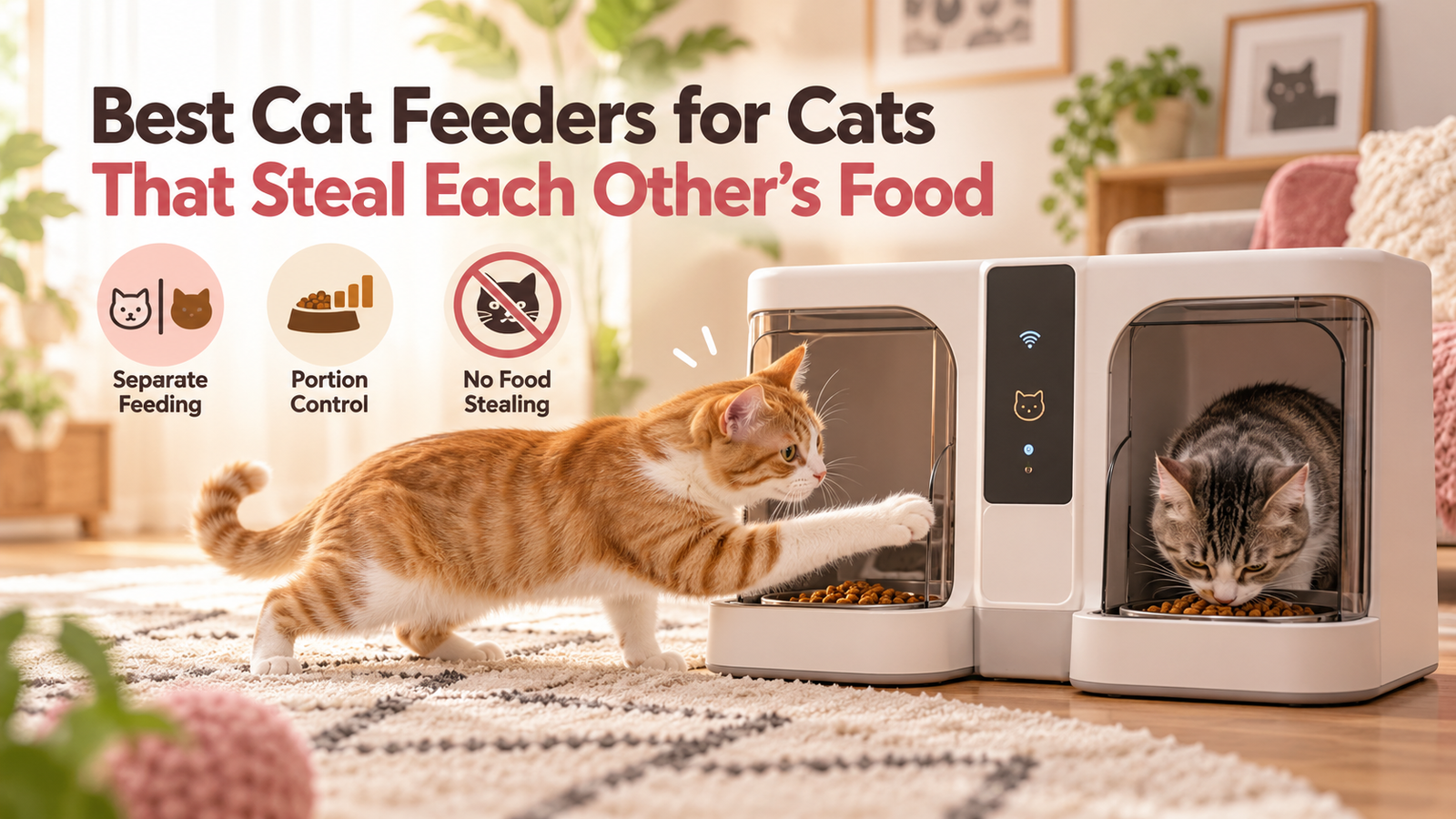
Best Cat Feeders for Cats That Steal Food
Quick Answer:
The best cat feeders for cats that steal each other’s food are selective-access feeders that recognize an individual cat before opening the food bowl. SureFeed Microchip Pet Feeder is a strong collar-free choice, while PETLIBRO One RFID offers scheduled dry-food dispensing with collar-tag access control.
If you live with multiple cats, you may know the routine.
One cat finishes breakfast in seconds, walks across the kitchen, and begins eating from another cat’s bowl.
Meanwhile, the slower cat steps away, leaving part of its meal behind.
Occasional food stealing might seem harmless, but repeated stealing can make feeding routines difficult—particularly when cats need different portions or veterinary-prescribed diets.
The challenge becomes greater when one cat prefers grazing throughout the day while another eats everything immediately.
Fortunately, there are ways to separate food access without constantly supervising every meal.
Microchip and RFID feeders offer different approaches. Some protect a bowl that you’ve filled yourself. Others automatically dispense dry kibble according to a schedule.
In this buying guide, we’ll compare the most useful options, explain their limitations, and help you decide which approach fits your cats.
How we evaluated these products: This guide is based on documented manufacturer specifications, identification technology, feeding functionality, and practical suitability for multi-cat households. We have not performed independent hands-on testing. Product availability and features should be verified for the exact model before purchase.
🏆 Quick Verdict: Best Cat Feeders to Stop Food Stealing
For most households where one cat steals another’s food, SureFeed Microchip Pet Feeder is our leading starting point because it recognizes compatible implanted microchips and doesn’t require the authorized cat to wear a collar.
For owners who also need automatic meal scheduling, PETLIBRO One RFID offers a different solution: it dispenses dry food and controls access using a dedicated RFID collar tag.
For closer monitoring of an individual cat’s eating habits, SureFeed Microchip Pet Feeder Connect adds portion weighing and feeding records.
Quick Comparison Table
| Feeder | Identification | Automatically Dispenses Food? | Food Type | Best For |
|---|---|---|---|---|
| SureFeed Microchip Pet Feeder | Implanted microchip or supported RFID tag | No | Wet and dry | Protecting an individual food bowl |
| SureFeed Microchip Pet Feeder Connect | Implanted microchip or supported RFID tag | No | Wet and dry | Monitoring a cat’s eating habits |
| PETLIBRO One RFID | Dedicated RFID collar tag | Yes | Dry kibble | Scheduled meals with controlled access |
All three use access-control technology, but they solve slightly different problems.
A selective-access feeder doesn’t always mean an automatic portion dispenser.
I Would Choose
- SureFeed Microchip Pet Feeder if my cat is already microchipped and prefers to eat slowly.
- SureFeed Connect if tracking how much a particular cat eats is important.
- PETLIBRO One RFID if I need both scheduled dry-food portions and individual access control.
- Separate feeding rooms before buying an expensive device if food stealing happens only during supervised meals.
I Would Not Choose
- A regular open-bowl automatic feeder to prevent stealing between cats.
- A collar-tag-only feeder for a cat that cannot safely or comfortably wear a collar.
- A dry-food-only dispenser for a cat that exclusively eats wet food.
- An expensive connected feeder when supervised feeding in separate rooms already solves the problem.
📖 In This Guide
1. Why Cats Steal Each Other’s Food
2. The Best Cat Feeders for Food-Stealing Problems
3. Microchip vs RFID Cat Feeders
4. Which Feeder Fits Your Cats?
5. How Many Feeders Do You Need?
6. How to Train Cats to Use Selective Feeders
7. How to Prevent Food Stealing Without Technology
8. What to Check Before Buying
9. Frequently Asked Questions
🐈 Why Do Cats Steal Each Other’s Food?
Food stealing doesn’t always mean a cat is being aggressive or deliberately bullying another pet.
Cats have different appetites, feeding preferences, and social behaviors.
Understanding the likely cause can help you choose a better solution.
1. Different Eating Speeds
One cat may finish its food quickly while another prefers several smaller meals.
If food remains accessible, the faster eater may help itself to the leftovers.
This is particularly common in households where cats are free-fed from separate open bowls.
2. Different Food Preferences
Some cats may prefer another cat’s food because it smells or tastes more appealing.
The problem can become serious when one cat receives a prescription diet and another eats standard food.
3. Competition Around Feeding Areas
Cats may feel uncomfortable eating near each other.
A confident cat might approach another’s bowl, causing the more cautious cat to leave.
Even without fighting, this pattern can create stressful feeding situations.
4. Hunger or Changing Appetite
A cat that suddenly begins seeking significantly more food may have a change in appetite.
Sometimes this relates to feeding routines, but medical conditions can also affect hunger.
If your cat’s appetite changes noticeably, especially alongside weight loss or unusual thirst, consult a veterinarian.
5. Learned Behavior
A cat may discover that approaching another bowl leads to extra food.
If the behavior repeatedly works, it can become part of the household routine.
The practical takeaway: The right feeder should address your cats’ actual eating patterns, not simply dispense more food.
⭐ 1. SureFeed Microchip Pet Feeder — Best Overall for Protecting Individual Meals
The SureFeed Microchip Pet Feeder is designed for households where one pet needs access to food that other animals should not eat.
Instead of dispensing kibble from a large hopper, it protects a food bowl behind a motorized lid.
When an authorized cat approaches, the feeder reads its implanted microchip or compatible RFID collar tag.
The lid opens to allow access.
When the cat leaves, the lid closes again.
Key Features
- Recognizes compatible implanted identification microchips
- Also supports SureFlap RFID collar tags
- Designed for wet and dry food
- Approximately 400 ml bowl capacity
- Stores up to 32 authorized pet identities
- Includes a gradual training mode
- Battery-operated using four C-cell batteries
- Sealed bowl design helps limit exposure to air and insects
Why It’s Our Leading Choice
Its main advantage is that it can protect a cat’s food without requiring a separate wearable tag when the cat already has a compatible implanted microchip.
This matters in homes where collars are inconvenient or unsuitable.
It also works well for cats that prefer grazing rather than eating an entire meal at once.
You fill the bowl, and the authorized cat can return to it throughout the day.
What We Like
- Collar-free access for compatible microchipped cats
- Supports wet and dry food
- No automatic kibble portion calibration required
- Useful for cats eating different diets
- Training mode for cautious cats
- Doesn’t require a Wi-Fi connection for basic operation
Limitations to Consider
- Doesn’t automatically dispense additional food from a hopper
- Owners must refill the bowl
- Some determined cats may attempt to follow the authorized cat into the opening
- Battery maintenance is required
- The open front and closing delay mean access control is not physically foolproof
Who Should Buy It?
This is a strong fit if:
- One cat regularly steals food from another.
- Your cats need different diets.
- A slower cat grazes throughout the day.
- Your cat already has a compatible microchip.
- You don’t need automatic meal dispensing.
PetsVibe Verdict: Best overall for protecting a prepared meal from other household pets, particularly when collar-free microchip access is a priority.
📊 2. SureFeed Microchip Pet Feeder Connect — Best for Monitoring Individual Eating
The SureFeed Microchip Pet Feeder Connect builds on the basic selective-access design.
It restricts bowl access through compatible microchip or RFID identification while adding connected feeding information.
This makes it particularly interesting for households where the owner needs more visibility into individual eating habits.
Key Features
- Selective microchip or compatible RFID access
- Supports wet and dry food
- Integrated weighing technology
- App-based feeding information
- Records feeding activity
- Helps monitor changes in food consumption
- Connected functionality through the Sure Petcare ecosystem
The connected features require compatible networking equipment and configuration. Check the exact package and hub requirements before purchase.
Why Feeding Records Matter
Imagine two cats sharing a home.
One is a healthy adult cat.
The other is older, eats more slowly, and follows a veterinarian-recommended diet.
A regular open bowl may make it difficult to know whether the older cat actually finished its meal.
The Connect model helps the owner monitor feeding behavior more closely.
This doesn’t replace observing the cat or seeking veterinary advice, but it can provide useful information.
What We Like
- Individual access control
- Food weighing
- Feeding records
- Suitable for wet and dry food
- Useful when monitoring portions matters
- Supports gradual familiarization with the opening lid
Limitations to Consider
- More complex than the basic SureFeed model
- Connected features require additional setup
- Food is still placed into the bowl manually
- Not a substitute for medical monitoring
- Added functionality may not justify the cost for every household
Who Should Buy It?
Consider this model if:
- One cat has a specialized feeding plan.
- You want to observe changes in individual food consumption.
- Several cats eat different diets.
- You value app-based feeding information.
- You prefer microchip access instead of collar-only identification.
PetsVibe Verdict: Best for owners who need selective food access and more detailed information about a particular cat’s eating behavior.
🥣 3. PETLIBRO One RFID — Best for Scheduled Meals and Food-Stealing Prevention
The PETLIBRO One RFID Smart Feeder takes a different approach.
Rather than simply protecting an already-filled bowl, it combines scheduled dry-food dispensing with access control.
The feeder recognizes a dedicated RFID tag worn on the cat’s collar.
When the correct cat approaches, the lid can open to provide access to its food.
Key Features
- RFID collar-tag identification
- Automatic dry-food dispensing
- Up to 10 scheduled meals or snacks daily
- Approximately 3-liter food tank
- Compatible dry kibble measuring approximately 2–15 mm
- App-based meal scheduling
- Feeding activity records
- Backup power using three D-cell alkaline batteries
- Adjustable lid-closing behavior
Important: It Does Not Read Implanted Microchips
This is the most important distinction between PETLIBRO One RFID and the SureFeed models.
PETLIBRO One RFID recognizes its dedicated collar tag.
It does not recognize the identification microchip already implanted under your cat’s skin.
The manufacturer also specifies that each feeder can pair with one dedicated RFID tag.
Therefore, if you want individual scheduled feeding for two cats, you generally need a separate compatible feeder for each cat.
Why It’s Useful for Multi-Cat Households
Suppose one cat is supposed to eat three measured meals daily while another receives a different amount.
A traditional automatic feeder might dispense food into an open bowl.
That solves meal scheduling, but it doesn’t prevent another cat from eating the portion.
PETLIBRO One RFID combines dispensing with identity-based access.
This offers a more suitable solution for owners who need both functions.
What We Like
- Automatic scheduled feeding
- Access control for an individual cat
- Useful for different dry-food feeding routines
- App-based scheduling
- Feeding history
- Documented battery-backup feeding behavior
Limitations to Consider
- Requires the cat to wear the dedicated tag
- Doesn’t recognize implanted microchips
- Dry food only
- Each unit recognizes one paired tag
- Requires app and Wi-Fi setup for connected functions
- Another cat may attempt to access the bowl while the authorized cat is eating
PETLIBRO documents a safety behavior in which the lid can reopen if another pet obstructs closing. That protects against an unsafe closing action, but it also demonstrates why the device cannot guarantee complete protection against every stealing attempt.
Who Should Buy It?
This feeder is especially worth considering if:
- You need scheduled dry-food meals.
- You have cats with different portion requirements.
- Your cat tolerates a properly fitted breakaway collar.
- You want feeding activity records.
- You’re comfortable using an app.
PetsVibe Verdict: Best for owners who want automatic dry-food dispensing and individualized RFID access in the same device.
⚖️ Microchip vs RFID Cat Feeders: What’s the Difference?
Microchip and RFID feeders may look similar, but not all identification systems are interchangeable.
An implanted identification microchip is placed under the pet’s skin.
An RFID collar tag is a separate device worn on a collar.
Both can help identify an authorized pet, but compatibility depends on the feeder.
| Feature | Implanted-Microchip Feeder | Collar-Tag RFID Feeder |
|---|---|---|
| Requires collar | No, when the microchip is compatible | Yes |
| Reads implanted ID chip | Yes | Not necessarily |
| Works with selected collar tags | Depends on model | Yes |
| Suitable for separate diets | Yes, with appropriate access setup | Yes, with appropriate access setup |
| Supports automatic portion dispensing | Depends on model | Depends on model |
| Requires internet | Depends on model | Depends on model |
| Main consideration | Microchip compatibility | Collar fit and tag compatibility |
Which Is Better for Cats That Dislike Collars?
A feeder that recognizes an implanted microchip is usually the more practical choice.
However, verify that the feeder supports your cat’s microchip standard.
Which Is Better for Scheduled Dry-Food Meals?
An RFID feeder with integrated automatic dispensing may be more convenient.
But make sure the device supports the number of meals and portion sizes your cat needs.
Is RFID Less Secure Than a Microchip?
That is not a useful blanket comparison.
Access reliability depends on the specific reader, physical bowl design, closing behavior, and how other cats behave around the feeder.
Neither technology makes food stealing impossible under every circumstance.
🛒 Which Feeder Should You Choose?
Before buying, identify your household’s actual feeding problem.
| Your Situation | Recommended Starting Point |
|---|---|
| One cat steals another’s wet food | SureFeed Microchip Pet Feeder |
| One cat wears no collar | SureFeed Microchip Pet Feeder |
| You want individual feeding records | SureFeed Connect |
| You need scheduled dry kibble | PETLIBRO One RFID |
| Cats require different dry-food portions | PETLIBRO One RFID with separate access setups |
| You need a simple low-cost solution | Separate feeding spaces |
| Your cats dislike moving lids | Supervised separate-room feeding during training |
What If One Cat Is Overweight?
A selective-access feeder can help restrict access to another cat’s food.
But successful weight management still depends on the cat’s total calorie intake, appropriate portions, activity, and veterinary guidance.
Access control is one part of the solution.
What If One Cat Needs Prescription Food?
Preventing another cat from eating a prescription diet may be important.
Likewise, the cat receiving the prescription food may need to avoid other bowls.
In these households, confirm that all feeding arrangements protect the relevant diets, not only one bowl.
Ask your veterinarian how strictly the diets need to be separated.
🏠 How Many Selective Feeders Do You Need for Two or Three Cats?
The answer depends on how many individual diets require protection.
You don’t necessarily need a selective feeder for every cat.
Two Cats: One Food Thief
If one cat eats a standard diet and repeatedly steals food from a slower cat, protecting the slower cat’s bowl may be enough.
The faster cat could continue using its usual supervised feeding arrangement.
Two Cats: Different Medical Diets
If both cats must avoid each other’s food, each may need a protected feeding location.
That could mean two compatible selective feeders or a combination of controlled access and physically separated meals.
Three Cats: One Greedy Eater
If two cats graze while one rapidly finishes every bowl, two protected feeding stations may help.
However, the exact arrangement depends on whether the cats share diets and how often they eat.
Three Cats: Different Feeding Requirements
A more structured system may be necessary.
Consider separate feeding stations, individual portions, and additional supervision.
Remember: A feeder’s ability to store multiple pet identities does not mean it can dispense different diets to those pets automatically.
Check whether identification controls access, portions, or both.
🐾 How to Train Your Cats to Use a Microchip or RFID Feeder
Some cats approach a new feeder immediately.
Others become suspicious when a lid moves or the device makes a noise.
Training should be gradual.
Step 1. Choose a Quiet Feeding Location
Place the feeder where the intended cat normally feels comfortable eating.
Avoid areas where another pet regularly blocks access.
Step 2. Let Your Cat Explore
Allow the cat to sniff and investigate the feeder without pressure.
Do not force its head into the opening.
Step 3. Use the Manufacturer’s Training Mode
If the feeder supports gradual lid training, begin with the least restrictive stage.
For example, SureFeed provides a training mode that introduces lid movement gradually.
Step 4. Offer Familiar Food
Use the cat’s normal food.
Avoid introducing a major diet change at the same time as a completely new feeding device unless medically necessary.
Step 5. Reward Calm Behavior
Allow your cat to approach and eat voluntarily.
Positive reinforcement can help create a more comfortable association.
Step 6. Introduce More Lid Movement Gradually
Move through training stages only when your cat appears relaxed.
Some cats adapt quickly; others require more time.
Step 7. Monitor Other Cats
Watch whether the food thief waits nearby, pushes into the opening, or intimidates the authorized cat.
The feeder may need to be moved to a quieter location.
Step 8. Confirm Reliable Access
Before relying on the feeder unsupervised, verify that the authorized cat can approach, open the lid, eat, and leave comfortably.
Also check that unauthorized cats cannot routinely take food.
🔒 Can Another Cat Still Steal Food From a Microchip Feeder?
Yes, in some circumstances.
Selective-access feeders reduce opportunities for food stealing, but their effectiveness depends partly on the physical design and behavior of other pets.
Tailgating
A second cat may approach closely behind the authorized cat while the lid is open.
Reaching Around the Feeder
Some cats may try to reach food from the side or rear.
A compatible rear cover or additional barrier may help on models that support it.
Intimidating the Authorized Cat
A confident cat may stand nearby and cause a more timid cat to leave before finishing.
The technology may control the lid, but it doesn’t eliminate social tension.
Blocking the Lid
Some feeders include safety mechanisms that respond when an object prevents closing.
These features protect pets, but persistent interference may leave food temporarily accessible.
How to Improve Protection
Try the following:
- Position the feeder away from busy walkways.
- Use manufacturer-approved accessories where available.
- Avoid placing competing bowls directly beside each other.
- Watch for tailgating behavior.
- Feed particularly competitive cats in separate rooms.
- Recheck the arrangement after introducing a new pet.
If a cat cannot eat comfortably because another pet is intimidating it, physical separation may remain the safest option.
💡 How to Stop Cats Stealing Food Without Buying a Smart Feeder
Before investing in a specialized product, consider whether simpler changes might resolve the problem.
1. Feed Cats in Separate Rooms
This is one of the most straightforward ways to prevent food stealing during scheduled meals.
Each cat receives its own food without another pet approaching the bowl.
The drawback is that the owner may need to supervise feeding and open the rooms afterward.
2. Switch From Open Grazing to Scheduled Meals
If appropriate for your cats, offer food at consistent times and remove leftovers after a suitable supervised period.
This limits opportunities for one cat to eat another’s food later.
However, not every cat benefits from the same feeding schedule.
3. Create More Distance Between Feeding Stations
Some cats eat more comfortably when their bowls are out of each other’s immediate view.
A quiet feeding location can also help reduce competition.
4. Use a Microchip-Activated Pet Door for a Separate Area
In some households, an access-controlled room or enclosure may offer a more complete separation than a protected bowl.
This arrangement requires suitable space, compatible equipment, and safe access.
5. Monitor Actual Food Intake
Measure what you offer and check what each cat actually eats.
If you’re unsure whether one cat is getting enough food, observation is more useful than assuming every prepared portion was consumed.
6. Address Behavioral and Medical Concerns
Sudden appetite changes, weight loss, or persistent aggression around food deserve appropriate attention.
Consult your veterinarian if the behavior is new or associated with other symptoms.
A feeder cannot diagnose an underlying medical or behavioral problem.
📋 What to Check Before Buying a Feeder for Multiple Cats
Use this checklist before making a purchase.
| Buying Question | Why It Matters |
|---|---|
| Does it recognize implanted microchips? | Important if your cat cannot wear a collar |
| Does it require a specific RFID tag? | Prevents compatibility mistakes |
| Does it dispense food automatically? | Determines whether you must refill prepared meals |
| Does it support wet food? | Essential for cats on wet-food diets |
| How many pets can be authorized? | Affects access arrangements |
| Does it identify each pet separately? | Necessary for individual restrictions |
| Can other cats reach food while the lid opens? | Helps assess real-world protection |
| Is a training mode available? | Useful for nervous cats |
| Does it need Wi-Fi? | Important for setup and connectivity |
| Does it offer battery operation? | Important during power interruptions |
| Are replacement parts available? | Affects long-term ownership costs |
| Can food-contact parts be cleaned easily? | Important for hygiene |
Don’t Confuse Capacity With Individual Feeding
A large food hopper doesn’t automatically solve food stealing.
A regular automatic feeder may release the right amount at the right time but allow whichever cat arrives first to eat it.
For households with food-stealing problems, access control matters more than hopper size alone.
🔗 Related Pet Tech Guides
If you’re building a more reliable feeding setup, these PetsVibe Tech guides cover related problems and buying decisions.
Best Automatic Cat Feeders That Work Without Wi-Fi (This Year)
Explore internet-independent feeding options and understand which features work without a connected app.
Automatic Cat Feeder Battery Backup: What Happens During a Power Outage?
Learn what continues working when electrical power fails and why backup batteries are not the same as offline scheduling.
Automatic Cat Feeder Not Dispensing Food? 9 Fixes That Actually Help
Troubleshoot kibble jams, incorrect schedules, mechanical problems, and other common dispensing failures.
❓ Frequently Asked Questions
1. What is the best cat feeder to stop cats stealing food?
SureFeed Microchip Pet Feeder is a strong choice when you want to protect a prepared meal using a compatible implanted microchip. PETLIBRO One RFID is more suitable when you also need automatic dry-food dispensing and scheduled portions.
2. Can a microchip cat feeder recognize multiple cats?
Some models can store multiple authorized identities. For example, SureFeed Microchip Pet Feeder supports up to 32 registered pets. That does not mean it automatically provides a different food or portion to each registered pet.
3. Does PETLIBRO One RFID work with implanted microchips?
No. The PETLIBRO One RFID uses its dedicated collar tag. It does not read the identification microchip implanted under your cat’s skin.
4. Can two cats share one PETLIBRO One RFID feeder?
The model is designed around one paired RFID tag per feeder. If both cats require individually controlled access and feeding schedules, separate units or another feeding arrangement may be necessary.
5. Do microchip cat feeders work with wet food?
Some do. SureFeed Microchip Pet Feeder supports wet and dry food. PETLIBRO One RFID, by contrast, is designed for compatible dry kibble.
6. Do selective-access feeders require Wi-Fi?
Not all of them. The basic SureFeed Microchip Pet Feeder operates without Wi-Fi. Connected models may require network setup for app-related functionality.
7. Can a cat steal food while another cat is eating?
Yes. Some determined cats may attempt to reach into an open feeder or follow the authorized pet. Monitor behavior and consider additional barriers or separate rooms if necessary.
8. Are microchip feeders safe for nervous cats?
Some models include training modes that introduce the moving lid gradually. However, nervous cats may require a longer adjustment period, and some may prefer a completely separate feeding space.
9. Are RFID cat feeders worth the money?
They can be worthwhile when they solve a recurring food-access problem. Their value depends on your cats’ diets, behavior, compatibility, and whether a simpler feeding arrangement would work.
10. What should I do if one cat keeps eating another cat’s prescription food?
Separate the feeding arrangements and speak with your veterinarian about the dietary requirements. A compatible selective-access feeder can help, but you still need to ensure that each cat reliably receives the correct food.
✅ Final Verdict: Which Cat Feeder Is Best for Food-Stealing Problems?
The best cat feeder for cats that steal each other’s food is one that controls access to food in a way that matches your cats’ eating habits.
For many households, SureFeed Microchip Pet Feeder is the strongest starting point because it protects wet or dry food without requiring a separate collar tag when the cat has a compatible implanted microchip.
If you want feeding records and closer portion monitoring, SureFeed Microchip Pet Feeder Connect offers additional functionality.
If your priority is automatic dry-food dispensing with personalized access, PETLIBRO One RFID is the more suitable type of device.
However, no feeder can guarantee that every cat will stop competing over food.
Correct placement, patient training, appropriate portions, and attention to each cat’s behavior remain essential.
And sometimes, the most effective solution is also the simplest: feeding cats in separate rooms.
The goal isn’t just to stop food stealing. It’s to help every cat eat the right food, in the right amount, without unnecessary stress.